Claude Code Refusing Your Game? What Changed and What to Do
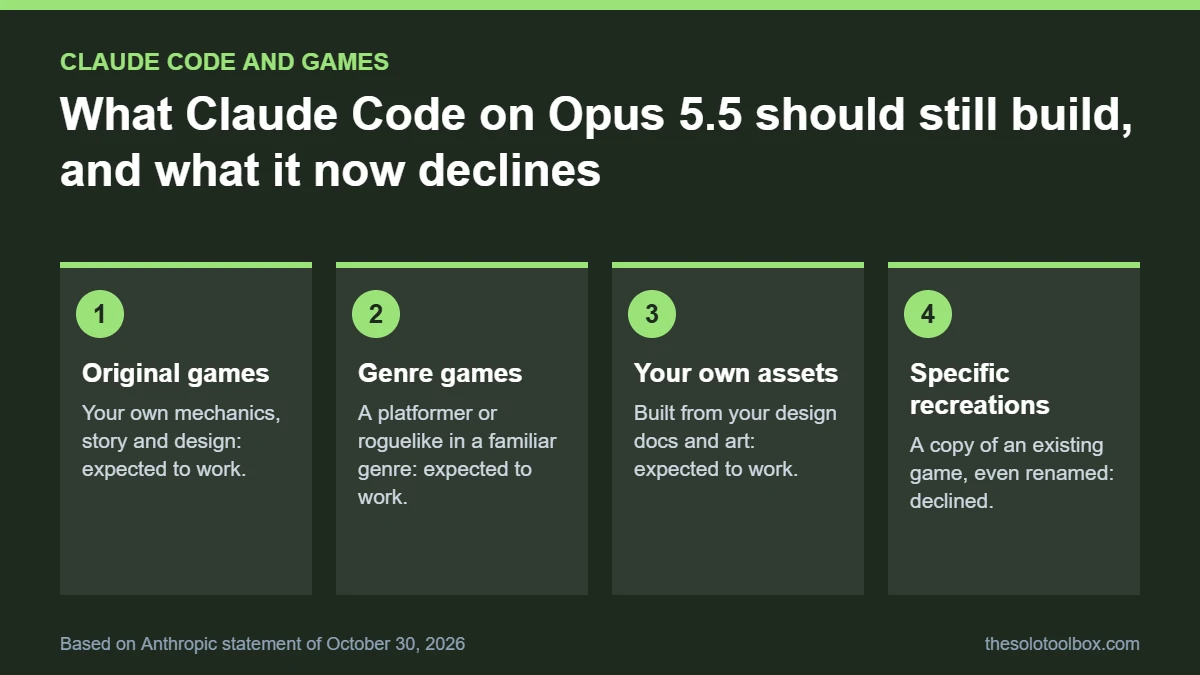
If Claude Code has started turning down your game project, it is probably because of a deliberate change. On October 30, 2026, Anthropic’s Addy Osmani confirmed that the company added two sentences to Claude Code’s prompt for the Opus 5.5 model to steer it away from recreating someone else’s specific game. Original games, genre games and games built from your own designs and assets are supposed to keep working. Separately, developers report Opus 5.5 in Claude Code refusing some reverse-engineering tasks since around October 31; Anthropic has not explained that publicly.
Below: what changed, which requests should still work, what is known about the reverse-engineering refusals, and what to do if Claude Code refuses work that is yours.
Before you start
- Who this is for: developers and hobbyists using Claude Code with Opus 5.5 for game projects, emulators, modding or binary analysis.
- What we checked: Anthropic’s public statement as reported by Tom’s Hardware, a GitHub issue describing the prompt text, and Claude Code’s model configuration docs.
- What we could not verify: the exact wording Anthropic added, and whether the reverse-engineering refusals come from the same change.
- Not covered here: how to get a model to produce a copy of someone else’s game. That breaks Anthropic’s usage policy whatever model or tool you use.
What Anthropic changed in Claude Code
Developers began posting game-related refusals on the Claude Code GitHub repository and social media in late October. On October 30, Osmani replied publicly that Anthropic had added two sentences to Claude Code’s prompt on Opus 5.5 because using Claude to infringe intellectual property is against its usage policy. He said Anthropic would keep adjusting the rule and asked developers to send him refusals of work that is theirs.
Anthropic has not published the added sentences. A screenshot shared on X, and a GitHub issue filed on November 1 (#106591), quote similar text: build original games, genre games and games from the user’s own designs and assets, but not a recreation of a specific existing game, even one that has been renamed or described as original. Tom’s Hardware reports that the game restriction appears to apply to the combination of Claude Code and Opus 5.5.
Which game requests should still work
Based on Anthropic’s statement, this is how the rule is meant to sort requests. Real behavior may differ while Anthropic tunes it.
| Request | Expected result |
|---|---|
| An original game with your own mechanics and story | Should work |
| A game in an established genre (platformer, roguelike, deck-builder) | Should work |
| A game built from your own design documents and art | Should work |
| A recreation of a specific existing game, even renamed | Declined |
| A private copy of a commercial board game to play with friends | Declined in at least one reported case (GitHub #106591) |
The last row matters for hobbyists. The developer behind issue #106591 asked Claude Code to implement a published cooperative board game for private play and strategy study, and was refused. The issue argues that the refusal was worded as Claude’s own judgment rather than as a product rule, which made it harder to understand what had happened.
What about reverse-engineering refusals?
These are less clear. Tom’s Hardware reports direct accounts of Opus 5.5 in Claude Code declining reverse-engineering tasks, including a developer testing his own software who said the same work had run without issue until October 31 and continued after he switched to Opus 4.8. A Reddit user also claimed an account suspension, later reversed, after using Opus 5.5 for reverse engineering. We could not confirm that report.
Claude Code’s own model configuration docs say offensive security workloads, such as penetration testing and Capture the Flag exercises, trigger model fallback often, sometimes on the first request, and call this expected routing rather than an account flag. Anthropic also runs a Cyber Verification Program that gives approved organizations access to fuller cybersecurity capabilities.
What to do if Claude Code refuses your own project
- Describe the game on its own terms. Explain the mechanics, rules and art direction you want, and point Claude Code at your design document or asset folder. A request that starts with “make me a copy of” a commercial title is exactly what the rule is written to stop.
- Put the context in CLAUDE.md. Claude Code reads a CLAUDE.md file in your project. A short note there stating that the game, code and assets are original, with a link to your design document, gives every session the same context instead of repeating it in each prompt.
- Check which model is running. Type
/modelin Claude Code to see the active model and switch between those your plan offers. The reported restriction is specific to Opus 5.5 in Claude Code. Anthropic’s usage policy, including the ban on IP infringement, applies to every model. - Report false refusals. If Claude Code declines work that is clearly yours, open an issue on the anthropics/claude-code GitHub repository with the request, the refusal text and the model in use. Remove API keys, private code and personal data first.
- For professional security work, go through official channels. If your job involves binary analysis or penetration testing, ask your Anthropic account team about trusted access programs, as the Claude Code docs suggest.
Do not try to rename or disguise a clone to get it past the rule. The rule as quoted covers renamed recreations, and a policy violation can put your account at risk.
What it means for you
For most people building original games, nothing should change. If you used Claude Code to rebuild classic games as learning exercises, expect refusals with Opus 5.5 and pick original or genre projects instead. The bigger lesson is that a coding agent’s behavior can change between one week and the next without a version bump on your side, so keep a short log of prompts that stop working.
If you have not looked at how Claude picks and switches modes lately, our guide to switching Claude auto mode to manual covers that, and our explainer on the Claude Ultra plan’s usage limits helps if you are deciding which plan you need. Before letting any agent work in folders you did not create, read our warning about AGENTS.md files planted in Downloads folders.
FAQ
Does the game restriction apply to the Claude app as well?
Anthropic’s statement refers to Claude Code’s prompt on Opus 5.5. We have not seen confirmation that the Claude web or desktop apps use the same added sentences.
Can I still make a game inspired by one I like?
Yes, according to Anthropic’s statement, as long as it is an original game or a game in that genre. A specific recreation, even under a new name, is what gets declined.
Will Anthropic loosen the rule?
Osmani said Anthropic will keep iterating to strike the right balance, but gave no timeline or specifics.
Related guides
- How to check if the malicious Claude Code extension hit your Cursor
- ChatGPT and Codex Will Share One Usage Limit From December. Here’s How to Prepare
- How to log out of ChatGPT and Claude on all devices
Sources
How we checked: we read Tom’s Hardware’s November 2 report, GitHub issue #106591 on the anthropics/claude-code repository, and Claude Code’s model configuration documentation on November 2, 2026.
- Tom’s Hardware: Anthropic confirms new Claude Code limits to prevent game cloning (November 2, 2026)
- GitHub issue #106591: Refusals driven by a product instruction are worded as Claude’s own judgment (November 1, 2026)
- Claude Code docs: Model configuration
Next step: if a refusal hit your own project, add a CLAUDE.md note describing it and retry with your design document attached; if it still fails, file a GitHub issue with the details.