FBI Crime Database Hack: What It Means and Scams to Expect
The Solo Toolbox · Software Help for One-Person Businesses
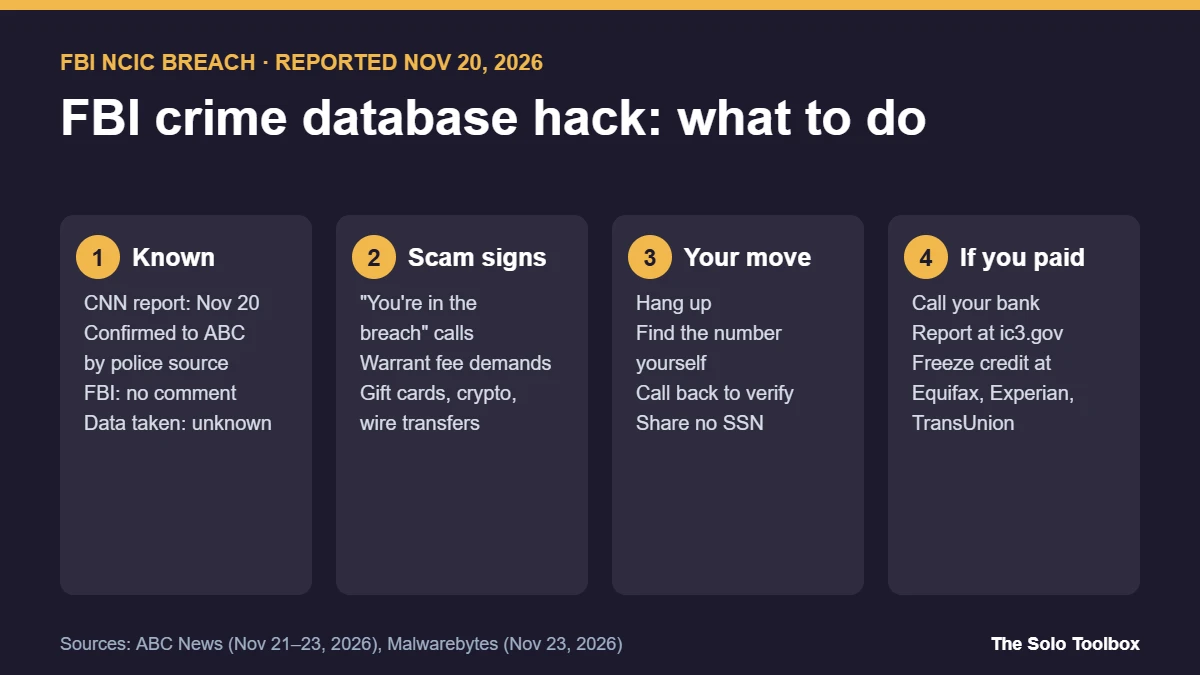
The FBI’s National Crime Information Center (NCIC), the database police check for warrants, stolen property and missing persons, was hacked, according to CNN’s November 20 report and a law enforcement source who confirmed it to ABC News. The FBI has not commented, and nobody has said publicly what was taken or who did it. For most people the practical risk right now is scams: callers posing as police or FBI agents who use the news, or real record details, to demand payment.
This article covers what’s confirmed, what NCIC holds, who could be affected, and how to handle a call or message that claims to be from law enforcement.
Before you start
- Applies to: anyone in the US, especially people who have a criminal record, an active protection order, a missing-person report in the family, or who have reported a stolen car or gun.
- You’ll need: nothing to install. Keep your local police non-emergency number and the FBI field office list handy for call-backs.
- How we checked this: on November 24, 2026 we read ABC News’ report (updated November 23) and Malwarebytes’ summary of CNN’s November 20 report. Our tools could not open CNN’s article directly. The FBI has declined to comment and has not confirmed the breach, so details may change.
What’s confirmed so far
| Date (2026) | Report |
|---|---|
| November 20 | CNN reports the FBI is investigating a breach of NCIC, citing two people briefed on the investigation |
| November 21 | President Trump says in a Fox News phone interview that NCIC was targeted, adding “it’s not good” |
| November 21–23 | A law enforcement source confirms the hack to ABC News; the FBI declines to comment |
What isn’t known: when the intrusion started, how the attackers got in, who they are, and whether any records were copied. Malwarebytes notes this is the second reported intrusion involving FBI systems in about two months, after a September breach that exposed employee information.
What the NCIC database holds
NCIC is run by the FBI’s Criminal Justice Information Services (CJIS) division and is used by local, state and federal agencies. According to ABC News and Malwarebytes, it contains:
- Wanted persons and outstanding warrants
- Criminal history information
- Missing persons
- Protection orders
- Stolen vehicles, firearms and other property
Malwarebytes, citing FBI figures, says NCIC held more than 19.3 million records in fiscal year 2025. NCIC is also one of the databases checked during gun purchase background checks, but none of the reports say the background check system itself was breached or that gun buyers’ details were exposed.
Who could be affected
Until the FBI says what was accessed, nobody can be told they were affected, and no notification process has been announced. Exposure would matter most for:
- People with a record or open warrant, whose names and case details could be used to make an extortion call sound convincing.
- People protected by a protection order, since those records describe the protected person and the restrained person. If you have safety concerns, speak with your local police department or victim advocate rather than waiting for official news.
- Families of missing persons, who are already targets of fake tip and ransom scams.
- Police officers and agencies, whose access details or query records could be used for targeted phishing.
If you’ve never been arrested, had a protection order or reported something stolen, you are unlikely to be in NCIC at all. The scam calls that follow a story like this don’t depend on whether you are.
The scams to expect
Fake-law-enforcement calls are already common, and a real breach gives scammers a fresh script. Watch for:
- A caller claiming to be an FBI agent or deputy who says your information “was in the breach” and asks you to verify your Social Security number or bank details
- A “warrant for your arrest” call that quotes a real-sounding case number and demands a payment to clear it
- Emails or texts styled as FBI breach notices with a link to “check your record”
- Offers to remove your name from the database for a fee
No US law enforcement agency asks for payment in gift cards, cryptocurrency, wire transfers or payment apps, and none clears a warrant over the phone. We covered the standard version of this con in detail in our guide to the fake FBI agent call scam.
What to do if someone contacts you
- Don’t confirm personal details, and don’t press any keys or click links in the message.
- Hang up or close the message. Caller ID can be spoofed to show a real agency number.
- Look up the agency’s number yourself: your local police department’s website, or the FBI field office list at fbi.gov. Call that number and ask whether the contact was genuine.
- If you lost money or shared details, call your bank immediately, then report it at ic3.gov, the FBI’s Internet Crime Complaint Center.
- If you shared your Social Security number, place a free credit freeze at Equifax, Experian and TransUnion.
Precautions worth taking this week
- Turn on two-step verification for your email and bank accounts; our guide to two-step verification for Google and Microsoft covers the two most common email providers.
- Check whether your email address has turned up in other breaches with the steps in how to check whether your email was in a data breach. Scammers often combine records from several leaks.
- Walk older relatives through the police-impersonation script, including the rule that real officers never take payment by phone.
Frequently asked questions
Was my data stolen in the FBI database hack?
Nobody knows yet. The FBI hasn’t confirmed what was accessed, and none of the reports say records were copied. Treat any message claiming to confirm your exposure as suspicious.
Will the FBI notify people who were affected?
No notification plan has been announced. If one is, it will be published on fbi.gov, not sent first by an unsolicited call or text.
Does this affect gun background checks?
Reports say NCIC is one of the databases checked during background checks, but none say the background check system or buyers’ data was breached.
Should I freeze my credit?
It isn’t required because of this news alone. A freeze is free, stops new accounts being opened in your name, and is worth doing if you’ve given your SSN to a caller or been caught in another breach.
What to do next
Save your local police non-emergency number in your phone today so a call-back takes seconds, and share the “no gift cards, no crypto” rule with family. We’ll update this page when the FBI says what was accessed.
Related guides
Sources
- ABC News: FBI’s national crime database targeted in hack, Trump says (November 21, 2026, updated)
- Malwarebytes: FBI crime database reportedly hacked (November 23, 2026)
- CNN: report on the NCIC breach (November 20, 2026)
- FBI Internet Crime Complaint Center (IC3)
Last checked: November 24, 2026. If something here is out of date, let us know.