Azure API Management Breach: Which Secrets to Rotate Now
The Solo Toolbox · Software Help for One-Person Businesses
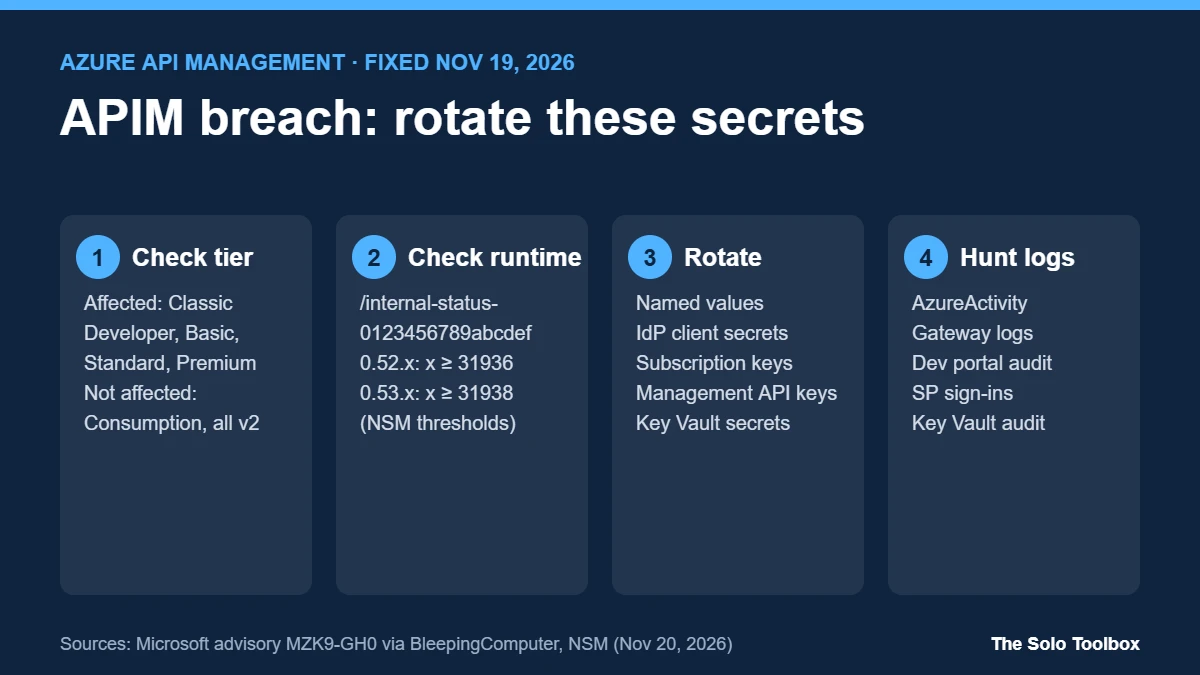
Attackers used a flaw in Azure API Management (APIM) to reach the management plane of some customer instances and go after stored secrets, subscription keys and identity provider client secrets. Microsoft closed the access path on November 19, 2026, but that fix does not invalidate anything stolen before it, so if you run an APIM Classic instance on the Developer, Basic, Standard or Premium tier, rotate those credentials now. Consumption tier and all v2 tiers are not affected, according to Microsoft.
This guide covers who is affected, how to check your gateway’s runtime version, which credentials to rotate in which order, and where to look in your logs.
Before you start
- Applies to: Azure API Management Classic instances on the Developer, Basic, Standard or Premium tier. Not the Classic Consumption tier and not any v2 tier.
- You’ll need: Contributor (or API Management Service Contributor) rights on the APIM instance, access to the Key Vaults and Entra app registrations it uses, and someone who owns each backend API so keys can be swapped without an outage.
- How we checked this: on November 24, 2026 we read BleepingComputer’s report of November 23, which quotes Microsoft’s Azure Service Health advisory (tracking ID MZK9-GH0), the advisory from Norway’s National Security Authority (NSM) dated November 20, and Anders Kristiansen’s technical write-up of November 21. We have not seen Microsoft’s advisory text directly; it is visible only to signed-in Azure customers. No CVE had been published when we checked.
What happened
| Date (2026) | Event |
|---|---|
| November 17 | Equinor discloses a cyberattack; it later says it stopped the attack and found no sign of data theft |
| November 18 | Microsoft identifies the APIM vulnerability; Skagerak Energi reports an attempted attack with no operational impact |
| November 19 | Microsoft deploys a mitigation, closes the unauthorized access path and rotates Microsoft-controlled keys |
| November 20 | NSM tells Norwegian organizations to assume APIM secrets are compromised and rotate them |
| November 23 | Microsoft’s Service Health advisory is reported publicly by BleepingComputer |
Per BleepingComputer, Microsoft says the flaw allowed unauthorized management-plane access to instances that were not configured according to its recommended security practices. NSM says an unknown actor actively targeted access tokens, secrets and named values stored in APIM, and that the full extent of exploitation is still unclear.
Which APIM tiers are affected
| Tier | Affected? |
|---|---|
| Classic Developer | Yes |
| Classic Basic | Yes |
| Classic Standard | Yes |
| Classic Premium | Yes |
| Classic Consumption | No |
| Basic v2, Standard v2, Premium v2 | No |
To confirm your tier, open the instance in the Azure portal and read Pricing tier on the Overview page.
What may have been exposed
Microsoft lists four kinds of data that could have been read through the flaw:
- Secrets stored in Named values, including values that hold backend API keys or connection strings
- Client secrets for identity providers and OpenID Connect providers configured in APIM
- Subscription keys that your API consumers use to call your APIs
- Tokens for the direct management APIs
If a named value is a Key Vault reference, the secret itself sits in Key Vault, but APIM’s managed identity can read it. Treat those secrets as exposed too, since the attacker’s access was at the management plane.
Step 1: Check your gateway’s runtime version
NSM’s advisory gives a quick way to see whether a self-checked instance has the update. Open this address in a browser, replacing the host name with your gateway’s:
https://<your-gateway-hostname>/internal-status-0123456789abcdef
Read the RuntimeVersion value and compare it with NSM’s thresholds:
| RuntimeVersion | Status per NSM |
|---|---|
| 0.52.x with x of 31936 or higher | Patched |
| 0.53.x with x of 31938 or higher | Patched |
| 0.52.x or 0.53.x with a lower last number | Still vulnerable; contact Microsoft support |
NSM also notes that version strings in a different pattern belong to v2 or Consumption instances, which are not affected. Microsoft says its fix needed no customer action for Microsoft-hosted gateways, but a patched runtime only stops new access. It does nothing about secrets already taken.
Step 2: Rotate credentials, highest impact first
Rotate in this order, because the first items give an attacker access beyond APIM itself:
- Backend credentials stored in Named values. In the APIM instance, open Named values and list every secret-type value. Issue a new key or password at each backend system, update the named value (or the Key Vault secret it references), then revoke the old credential at the backend.
- Identity provider client secrets. For each provider under the developer portal’s Identities page, and each OpenID Connect provider, create a new client secret in the Entra admin center under App registrations > your app > Certificates & secrets, paste it into APIM, then delete the old secret.
- Subscription keys. Open Subscriptions, and for each one regenerate the key your consumers are not currently using, hand it over, then regenerate the other. Each subscription has a primary and secondary key, which lets you do this without downtime.
- Management API access keys. If the direct Management API is enabled, regenerate both keys on the instance’s Management API page.
- Key Vault secrets APIM can read. Rotate any secret that APIM’s managed identity has permission to get, even if no named value currently points at it.
Kristiansen’s write-up also suggests turning off the old direct Management API on every instance if you don’t use it. That API runs at <instance>.management.azure-api.net, authenticates with a shared access signature instead of Entra ID, and its calls do not appear in the Azure Activity log. Microsoft retired it in March 2025, but retired does not mean switched off on existing instances.
Step 3: Look for signs of misuse
Microsoft tells customers to review logs and investigate activity in any system reachable with the exposed credentials. If you send APIM and Azure logs to Log Analytics, these tables are the places to start, based on Kristiansen’s threat-hunting queries:
- AzureActivity: list-secrets operations on named values, subscriptions and identity providers, plus writes to policies, users and the developer portal
- ApiManagementGatewayLogs (or AzureDiagnostics): subscription IDs that appear in the last seven days but not in the 30 days before, and requests with tracing turned on
- APIMDevPortalAuditDiagnosticLog: unexpected sign-ups or user changes in the developer portal
- AADServicePrincipalSignInLogs: sign-ins by APIM-linked app registrations from IP addresses you haven’t seen before
- AZKVAuditLogs: SecretGet and SecretList calls on vaults APIM uses, from callers you don’t expect
Check the backends too. A stolen database connection string or partner API key will show up in that system’s own logs, not in APIM’s. If logging wasn’t enabled before November 19, you may not be able to rule out access, which is one more reason to rotate rather than wait for evidence.
What we could not verify
A Reddit thread in r/sysadmin claims attackers reached Key Vault with a valid administrator token and used an unlogged legacy API. BleepingComputer says it has not verified those claims, and neither have we. Microsoft has not said how many customers were affected or published a CVE. We’ll update this page if that changes.
Frequently asked questions
Do I need to install an update?
Not for Microsoft-hosted gateways. Microsoft says its November 19 fix required no customer action. If you run a self-hosted gateway or your RuntimeVersion is below NSM’s thresholds, contact Microsoft support.
I use APIM v2. Am I safe?
Microsoft says the v2 tiers and the Classic Consumption tier were not affected. You don’t need to rotate because of this incident, though reviewing who can read your named values is still sensible.
Is this related to the Entra Connect Health breach?
They are separate flaws disclosed in the same week. The Entra Connect Health issue exposed tenant metadata and admin emails; the APIM flaw could expose actual secrets, so it calls for credential rotation.
How do I know if my tenant got a notice?
In the Azure portal, open Service Health > Security advisories and search for tracking ID MZK9-GH0.
What to do next
Confirm your tier today, then work through the rotation list starting with backend credentials. If you have already rotated API keys for another incident this month, such as the OpenRouter prompt leak, reuse that inventory so nothing gets missed.
Related guides
Sources
- BleepingComputer: Microsoft Azure flaw exploited to steal customers’ API credentials (November 23, 2026)
- NSM: Measures against vulnerability in Azure API Management (November 20, 2026, Norwegian)
- Anders Kristiansen: APIM legacy access and threat-hunting queries (November 21, 2026)
- Equinor: Cyber-attack stopped
- Microsoft Learn: Use named values in Azure API Management policies
Last checked: November 24, 2026. If something here is out of date, let us know.