FinCEN Filing Deadline Extended to Dec 30 After Cyber Incident
The Solo Toolbox · Software Help for One-Person Businesses
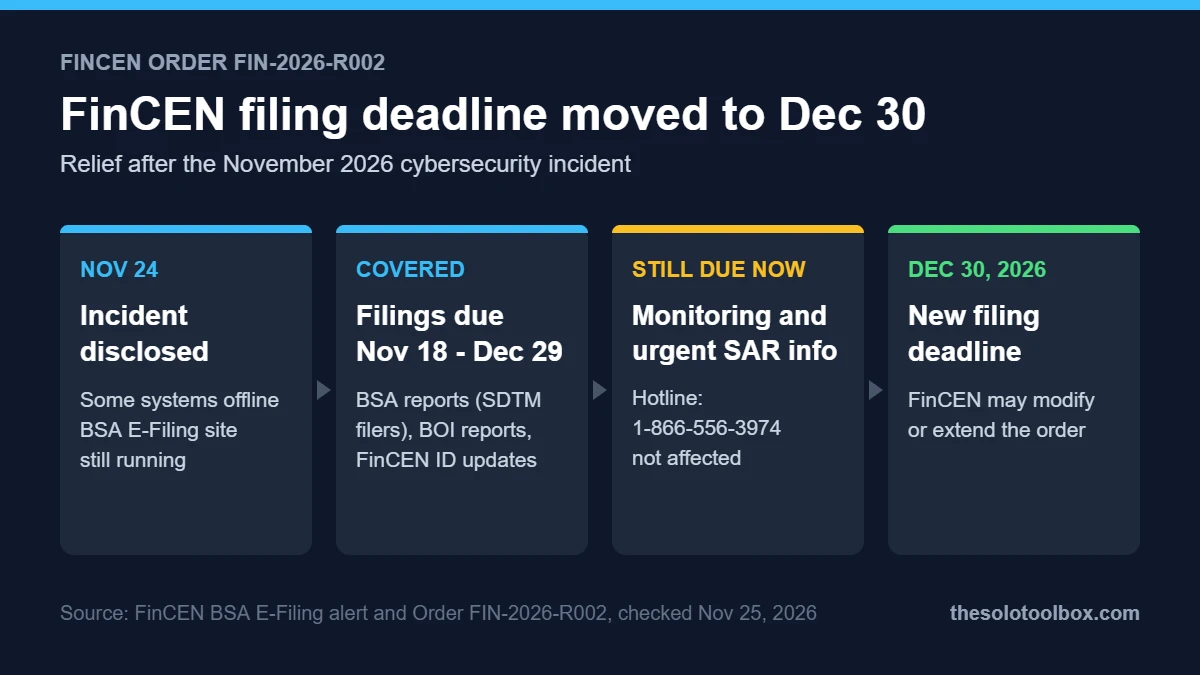
FinCEN has extended some Bank Secrecy Act and beneficial ownership filing deadlines to December 30, 2026 after a cybersecurity incident forced it to take some systems offline. The relief comes from FinCEN Order FIN-2026-R002, issued November 24, 2026, and it covers submissions that were due between November 18 and December 29, 2026, for two groups: financial institutions that file through Secure Data Transfer Mode (SDTM), and companies or individuals with Beneficial Ownership Information (BOI) or FinCEN ID filings.
This guide covers what FinCEN has confirmed, who the order applies to, what still has to be done on time, and how to tell a real FinCEN message from the impostor emails that tend to follow incidents like this.
Before you start
- Who this is for: compliance staff at banks, credit unions, money services businesses, casinos and broker-dealers; foreign companies registered to do business in the U.S. that still have BOI obligations; and accountants or filing agents who submit on their behalf.
- Time needed: about 10 minutes to check whether the order covers your filings.
- How we checked this: on November 25, 2026 we read the service alert on the BSA E-Filing System homepage, FinCEN’s November 24 news release, the text of Order FIN-2026-R002, FinCEN’s impostor scam guidance, and reporting from The Record. FinCEN has not said who was behind the incident or what data, if any, was taken. This is not legal advice; confirm your specific obligations with your compliance counsel.
What FinCEN has confirmed
The alert at the top of the BSA E-Filing System homepage, posted on the evening of November 24, says FinCEN is “investigating a cybersecurity incident” that resulted in unauthorized access to “a limited subset of its systems.” FinCEN’s statement covers four points:
- It has taken some systems offline as a precaution.
- The BSA E-Filing website itself is still running, but some services may be temporarily unavailable.
- It is extending deadlines for filers affected by the disruption.
- Its Financial Institutions Hotline, 1-866-556-3974, is not affected and can be used to get urgent suspicious activity information to law enforcement.
FinCEN has not said which systems were accessed, when the intrusion started, whether filing data was viewed or copied, or who is responsible. The Record reported that Treasury and FinCEN did not respond to its requests for comment. Until FinCEN says more, treat any claim about stolen SAR or BOI data as unconfirmed.
Who gets the December 30 deadline
Order FIN-2026-R002 grants “temporary, limited exceptive relief.” It has two parts:
| Who | What is covered | Original due window | New deadline |
|---|---|---|---|
| Financial institutions using SDTM as of November 18, 2026 | BSA reports required under 31 CFR Chapter X | November 18 to December 29, 2026 | December 30, 2026 |
| Reporting companies and individuals with a FinCEN ID | BOI reports and FinCEN ID updates under 31 CFR 1010.380 | November 18 to December 29, 2026 | December 30, 2026 |
Three details matter when you read the order:
- The SDTM condition. Part 1 is written for institutions that used SDTM, the batch system for large-volume filers, as of November 18. The order does not say whether institutions that file one report at a time through the BSA E-Filing website also qualify. If that is how you file and you are stuck, ask FinCEN rather than assuming you are covered.
- No specific forms are listed. The order refers to “BSA Reports” in general. It does not name CTRs, SARs or any other form individually.
- FinCEN can change it. The order says FinCEN may modify or extend it, so check the BSA E-Filing homepage again before December 30.
Does this affect BOI reporting for U.S. companies?
For most U.S. small businesses, no. FinCEN’s homepage notes that under its BOI rule (updated August 11, 2026), U.S. companies are exempt and no longer have to file BOI reports. Only certain foreign companies registered to do business in the U.S. still report. If you run a domestic LLC or corporation and someone contacts you about a “missed BOI deadline” because of this incident, treat it as a likely scam.
What still has to happen on time
The order moves filing deadlines. It does not pause your anti-money-laundering program. FinCEN says institutions must still meet all other BSA requirements, including ongoing monitoring for suspicious transactions. In practice, that means:
- Keep detecting and documenting. Continue investigations and record the date you decided a SAR was needed, so you can show your timeline later.
- Escalate urgent cases by phone. If something needs law enforcement attention now, such as ongoing fraud or terrorist financing, call the Financial Institutions Hotline at 1-866-556-3974.
- Queue filings rather than skip them. Prepare reports as usual and submit them once the affected service works again, no later than December 30.
- Save proof of the outage. Screenshot or log error messages, failed SDTM transfers and help-desk ticket numbers with dates. That record supports any later question about why a report arrived late.
- Use the right contact. Questions about the order go to FinCEN’s Regulatory Support Section at fincen.gov/contact. Technical filing problems go to the BSA E-Filing Help Desk.
Is FinCEN data safe after the breach?
Nobody outside FinCEN can answer that yet. The agency describes access to a “limited subset” of systems and has not said whether filing data was involved. The incident landed in the same week that U.S. intelligence agencies reportedly found a breach of an open-source intelligence system and the FBI was dealing with a breach tied to its fugitive database, which we covered in our guide to the FBI crime database hack. None of these incidents has been publicly linked to the others.
If you are an individual, you don’t need to do anything because of this incident today. If you are a filer, the useful step is the one above: keep records so you can respond quickly if FinCEN later notifies institutions about specific data.
How to spot fake FinCEN emails and calls
Government breaches give scammers a ready-made story. FinCEN’s own impostor scam page lists what it does not do. FinCEN does not:
- Send unsolicited emails, texts or letters, or call members of the public.
- Ask for payment by phone, text, email or mail, or demand immediate payment.
- Tell you to move money to a “safe” account.
- Freeze assets or contact you about blocked transfers.
- Ask you to pay to access your funds or to prove you aren’t involved in a crime.
- Offer grants or collect debts.
Expect messages that claim your filing “failed during the outage” and ask you to re-enter credentials or pay a fee. Don’t click the link. Go to bsaefiling.fincen.gov yourself, or verify through fincen.gov/contact. Report impersonation to Treasury’s Office of Inspector General and the FTC. The same rules apply to impostor phone calls; see our guide to the fake FBI agent call scam for the pressure tactics these callers use.
Frequently asked questions
Is the BSA E-Filing System down?
Not completely. As of November 25, FinCEN says the BSA E-Filing website “remains operational” but some services may be unavailable. FinCEN has not listed which services are affected.
Does the extension cover FBAR filings?
The order does not mention the FBAR (FinCEN Form 114). The individual FBAR deadline for 2025 accounts, including the automatic extension to October 15, 2026, has already passed for most filers, so this order is unlikely to change anything for them.
Do I need to apply for the extension?
The order does not describe an application process. Its relief applies to the groups listed above for filings due between November 18 and December 29, 2026.
Has FinCEN said who hacked it?
No. No group has claimed the attack, and FinCEN has not named a suspect.
What to do next
Check whether you filed through SDTM as of November 18 and list every report due before December 29. Set a December 30 deadline in your compliance calendar, keep outage evidence, and recheck the BSA E-Filing homepage for updates. If your business also handles customer accounts or payments, our checklist on what to do if your business email is hacked is worth reviewing while scam emails about this incident start circulating.
Related guides
Sources
- FinCEN BSA E-Filing System homepage: service disruption alert (accessed November 25, 2026)
- FinCEN: Temporary, Limited Exceptive Relief for Certain Bank Secrecy Act and Corporate Transparency Act Submissions (November 24, 2026)
- FinCEN Order FIN-2026-R002 (PDF, November 24, 2026)
- FinCEN: Recognizing Imposter Scams
- The Record: Treasury’s FinCEN takes systems offline after cybersecurity incident (November 25, 2026)
Last checked: November 25, 2026. If something here is out of date, let us know.