Binance Hack: What Users Should Do Now and Scams to Ignore
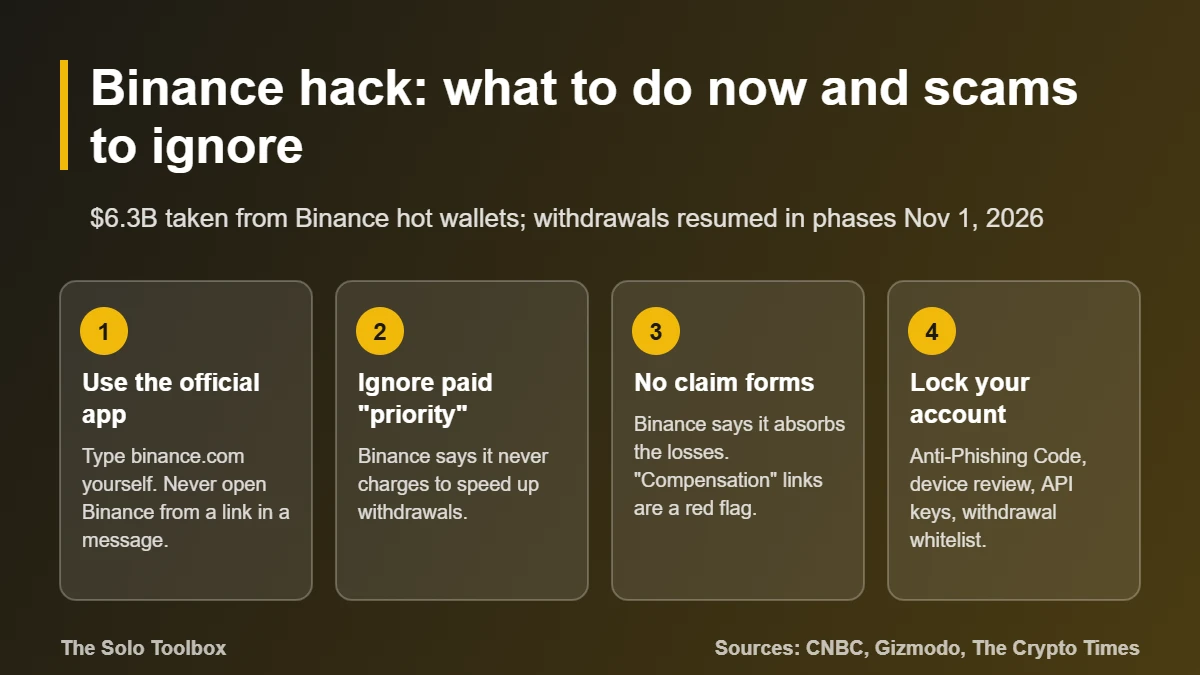
If you have a Binance account, the main risk this week is not the hack itself but the scam messages that followed it. Binance says it is covering the roughly $6.3 billion taken from its own hot wallets and restarted withdrawals in phases on November 1, 2026. On November 2, co-CEO Richard Teng warned that impersonators are offering “priority processing,” “compensation claims” and “secure vaults.” Binance says it will never contact you first, charge to speed up a withdrawal, or ask you to sign or move funds to unlock one. If someone instead pitches a different platform that promises to recover your losses, check whether the trading platform is real before you deposit anything.
Below: what happened and when, the security checks worth doing in your account now, how to spot the scams circulating, and what to do if you already responded to one. Facts were checked on November 2, 2026, against CNBC, Gizmodo and The Crypto Times reporting and Binance’s own verification tool. This is security guidance, not financial advice.
Before you start
- Who this is for: anyone with a Binance account, and anyone receiving messages that mention Binance refunds or withdrawals.
- What was stolen: funds from Binance’s hot wallets, not from individual customer logins, according to reporting so far.
- Golden rule: open Binance only from the official app or by typing binance.com yourself. Never from a link in a message.
- Not covered here: whether to keep funds on any exchange. That’s your call; we are not financial advisers.
What happened in the Binance hack
| Date (2026) | Event |
|---|---|
| Thursday, October 29 | Binance announces the theft of about $6.3 billion in tokens from its hot wallets and pauses withdrawals. It also warns users about scams during the recovery. |
| Saturday, October 31 | Binance says it has covered up to 90% of the stolen assets. The FBI says North Korea was responsible. |
| Sunday, November 1 | Withdrawals restart in phases, beginning with the Bitcoin network, then Ethereum and BNB Smart Chain. Binance reports about 95% covered. |
| Monday, November 2 | Fiat withdrawals added for USD, AED, VND, PHP and IDR. Teng posts the impersonation warning. |
Binance initially said the attack may have involved a compromised DevOps engineer’s laptop. Teng later said it was a more complex process. The exact method has not been published.
Binance says ten assets are fully backed at 100%: BTC, ETH, USDT, BNB, SOL, USDC, XRP, USD1, RLUSD and ZEC. The remaining gap, about $315 million as of November 1 per The Crypto Times, is in less liquid tokens that Binance is buying on the market. The money comes from its Secure Asset Fund for Users (SAFU), part of its futures insurance fund and its corporate treasury. These are Binance’s own figures.
According to Gizmodo, Binance’s accounting showed $4.649 billion in withdrawals against $1.01 billion in deposits during the first nine and a half hours after withdrawals reopened.
Do you need to do anything?
You don’t need to file a claim. In the statements we reviewed, Binance said it will absorb the losses and did not describe any claim form or compensation application for users. That’s exactly why “compensation claim” messages are a red flag.
What is worth doing is a 10-minute security check, because attackers know millions of people are logging in and checking balances this week.
Security checks to do in your Binance account now
- Open Binance the safe way. Use the official app or type binance.com into the address bar. Bookmark it and use only the bookmark.
- Set an Anti-Phishing Code. In your account’s Security settings, set a code that Binance will include in every genuine email. An email without your code is not from Binance.
- Review devices. In Security, open Device Management and remove any device you don’t recognize.
- Review API keys. Open API Management and delete keys you don’t use. Bots and trading tools you’ve stopped using are a common leftover.
- Turn on the withdrawal whitelist. This limits withdrawals to addresses you’ve saved, so a stolen session cannot send funds to a new address without extra steps.
- Use a passkey or authenticator app rather than SMS for two-step verification where Binance offers it.
Labels can differ slightly between the Binance app and website and between regions. If you can’t find a setting, use the search box in the app’s settings rather than a guide sent to you by someone else.
The Binance scams going around right now
| What the message says | What it asks you to do | Why it’s fake |
|---|---|---|
| “Priority withdrawal processing available” | Pay a fee or “gas” to jump the queue | Binance says it never charges to speed up withdrawals |
| “Claim your hack compensation” | Fill in a form, connect a wallet or enter your seed phrase | No claim process exists in Binance’s statements |
| “Move funds to a secure vault” | Send crypto to a new address | Binance says it never asks you to move funds to unlock access |
| “Verify your balance to re-enable withdrawals” | Log in through a link | Binance reopens withdrawals network by network; no verification link is involved |
| A tiny deposit with a message attached | Visit a site named in the transfer memo | Binance’s October 29 notice warned about small transfers carrying messages |
A Binance staff member summed up the pattern on X: legitimate withdrawals never require you to connect a wallet, sign a transaction or authorize access.
How to check if a message is really from Binance
Binance runs an official checker called Binance Verify. Paste in the URL, email address, phone number, Telegram handle or social media account that contacted you, and it tells you whether the source is official. Even a verified source should never ask for funds, your password, 2FA codes or a recovery phrase.
If you already clicked, signed or paid
- Stop. Don’t send more money to “unlock” a refund. Recovery scammers often come back for a second payment.
- Change your Binance password from the official app, then sign out of all devices in Device Management.
- Revoke wallet approvals if you connected or signed with a self-custody wallet. On Ethereum, Etherscan’s Token Approval Checker lists contracts that can spend your tokens. If you typed your recovery phrase anywhere, move the remaining funds to a new wallet with a new phrase.
- Contact Binance support through the app’s built-in support chat, never a phone number from a message.
- Report it to your national fraud agency. In the US, that’s the FBI’s IC3 at ic3.gov.
- Check whether your email was exposed elsewhere. Our guide on checking if your email was in a data breach shows how.
What we could not verify
We could not read Binance’s original October 29 announcement directly, so the timeline above relies on CNBC, Gizmodo and The Crypto Times. Coverage percentages and withdrawal figures are Binance’s own disclosures. How the attackers got in has not been explained publicly. The Binance menu labels above are the long-standing names of these features; we did not check every regional version of the app.
FAQ
Were individual Binance accounts hacked?
Reporting so far says the stolen funds came from Binance’s hot wallets, which the exchange controls, not from individual customer logins.
Is my money on Binance covered?
Binance says it will “absorb the financial impact” and that ten major assets are fully backed. Less liquid tokens were still being replenished as of November 2.
Who was behind the Binance hack?
The FBI said on October 31 that North Korea was responsible. Gizmodo reports it attributed the theft to the group known as TraderTraitor.
Should I withdraw my crypto from Binance?
That’s a personal decision that depends on your situation. This article doesn’t give financial advice. Whatever you decide, make withdrawals only from the official app or website.
Next step
Set your Anti-Phishing Code and turn on the withdrawal whitelist today, then run any Binance message you receive through Binance Verify before acting on it. For a wider account clean-up, see how to turn on two-step verification for Google and Microsoft, since your email account is the key to every exchange login.
Related guides
- Trezor CryptoBilis Implant Warning: What to Do If You Bought One
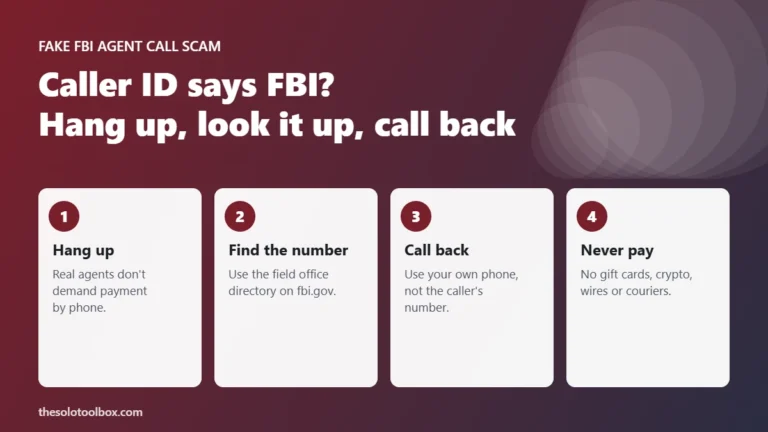
- Fake FBI agent call scam: how to tell and what to do
- Capcom data breach: what to do if you have a CAPCOM ID
If someone pushes you to deposit money on an investment or crypto trading site, check whether the trading platform is a scam first.
If you accept Bitcoin through BTCPay Server, check your BTCPay version and rebuild if needed.
Sources
- CNBC: Binance resumes withdrawals following record $6.3 billion hack (October 31–November 1, 2026)
- Gizmodo: Binance users pull billions off crypto exchange after withdrawals resume (November 2026)
- The Crypto Times: Binance warns of withdrawal scams as crypto services resume (November 2, 2026)
- Binance Verify (official verification tool)
- Etherscan Token Approval Checker