Trading Platform Scam? How to Check Before You Deposit
To check whether an online trading platform is real, look up the company’s legal name and exact web address on your financial regulator’s register and warning list before you send any money. Treat any platform that shows fast profits but delays or charges fees for withdrawals as a scam. These checks are free and take about 15 minutes.
On November 3, 2026, Europol said police in seven countries seized more than 100 servers and arrested seven suspects linked to a company suspected of supplying fake trading websites to scam call centres. Investigators counted potential victims in at least 50 countries and losses above €4 million. This guide walks through the checks that expose platforms like these, the red flags in that case, and what to do if you have already paid. We checked it against Europol’s release and guidance from the US Federal Trade Commission, IOSCO and the UK Financial Conduct Authority on November 3, 2026.
Before you start
- You’ll need: the platform’s full company name, its website address, any licence number it claims and the phone number or account that contacted you
- Time: about 15 minutes
- Key fact: a dashboard showing profits proves nothing. In the Europol case, victims’ accounts displayed fictitious gains
How the scam in the Europol case worked
According to Europol, the scheme ran in four stages:
- Ads, including affiliate marketing, promised quick returns from crypto, currency or stock trading and sent people to professional-looking platforms.
- The personal details people entered were sold to call centres, whose staff phoned them as “brokers.”
- Victims were asked for a small first deposit. Their account then showed invented profits, used to push for larger transfers.
- When victims tried to withdraw, the brokers stalled, then stopped answering.
The investigation began in 2022, when a German couple reported that they could not withdraw money from an online trading platform. That pattern, easy deposits and blocked withdrawals, is the clearest sign you are dealing with a fake.
How to check a trading platform before you deposit
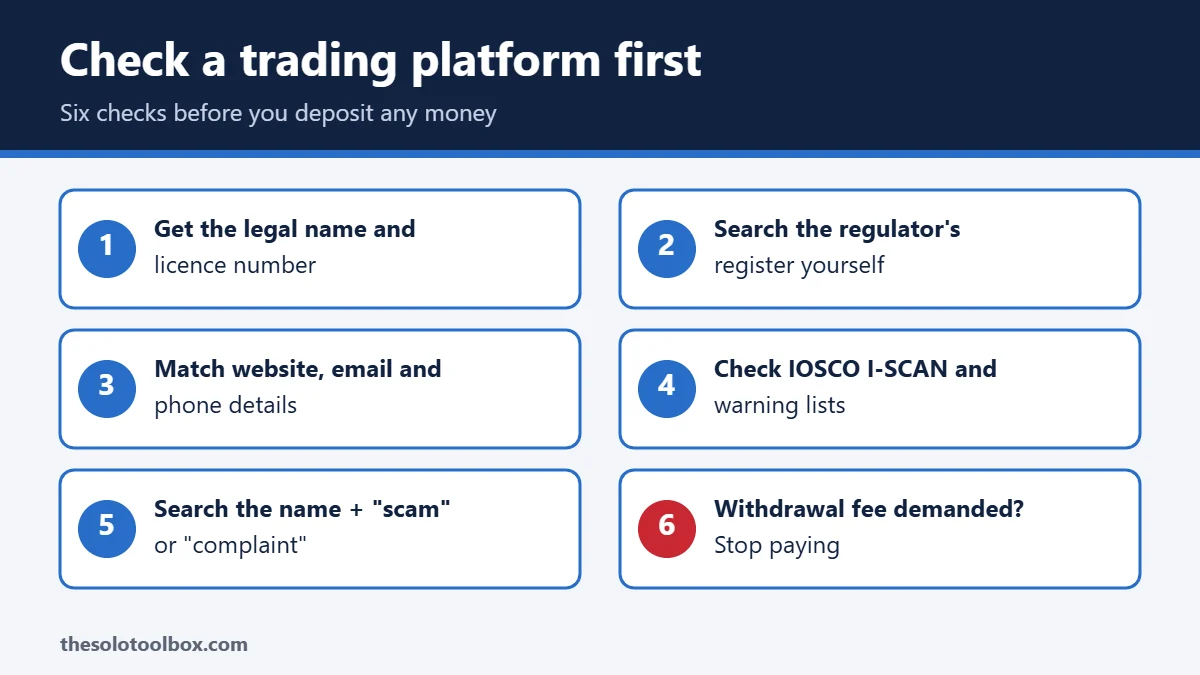
- Get the legal details. Ask for the company’s registered name, licence or registration number and the regulator it claims. A real broker will give these straight away. If it refuses or changes the subject, stop.
- Search the regulator’s register yourself. Type the regulator’s address into your browser rather than following a link the platform sends. In the US, use the search on Investor.gov or FINRA BrokerCheck. In the UK, use the FCA Register, linked from the FCA’s scam protection page.
- Match the contact details. Clone scams copy the name and number of a real authorised firm. Check that the website, email domain and phone number on the register match the ones you were given.
- Check warning lists. IOSCO’s I-SCAN collects alerts about unauthorised firms from securities regulators around the world. The FCA also keeps a Warning List of firms it knows are operating without permission.
- Search for complaints. The FTC suggests searching the company name with words like “review,” “scam,” “fraud” or “complaint” and reading several pages of results, not just the first.
- Think about how they found you. An unsolicited call, a social media message or an ad that promises guaranteed returns is a warning sign on its own.
One caution: a small withdrawal that goes through does not prove a platform is genuine. A fake platform can pay out a little to win trust before the larger deposits.
Real broker vs. scam platform
| Authorised broker | Scam platform | |
|---|---|---|
| Registration | Listed on the regulator’s register with matching contact details | Not listed, listed under a copied name, or “regulated” somewhere you can’t verify |
| Returns | Warns that you can lose money | Promises fast, high or guaranteed profits |
| Contact | You contact it; no pressure | Cold calls, DMs, daily pressure from a “broker” |
| Payments | To an account in the firm’s own name | To crypto wallets, personal accounts or changing payees |
| Withdrawals | Processed under published terms | Delayed, or blocked until you pay a “tax,” “fee” or “release” charge |
What to do if you already deposited
- Stop sending money. That includes any fee, tax or charge you are told is needed before a withdrawal can be released.
- Call your bank or card provider right away and tell them it was an investment scam. Ask what it can do to recall or dispute the payment. The sooner you call, the better the odds.
- Save evidence: screenshots of the dashboard, chat logs, emails, website addresses, transaction IDs and any wallet addresses you paid.
- Report it. In the US, the FTC points people to ReportFraud.ftc.gov and the SEC at sec.gov/tcr. In the UK, use the FCA’s report a scam page. Elsewhere, contact your national police or financial regulator.
- Don’t install remote-access apps or share your screen if a “broker” or “support agent” asks. That gives them control of your device and banking apps.
- Ignore anyone who offers to recover your money for an upfront fee. Victims of investment fraud are often targeted again by fake recovery services.
- If you sent copies of your ID, watch for identity theft. US residents can get a recovery plan at IdentityTheft.gov.
Scam callers often pose as officials once they have your details. Our guide to the fake FBI agent call scam covers how to verify a caller. If you hold crypto on an exchange, see the scams to ignore in our Binance hack guide.
FAQ
The platform has a real-looking app and live charts. Doesn’t that mean it’s legitimate?
No. A trading interface, live price charts and a support chat are cheap to build or rent. Europol’s case involved a company suspected of supplying ready-made fraudulent trading sites to criminal groups. Registration with a regulator is the check that counts.
It says it’s regulated in another country. Is that enough?
Check that country’s regulator register directly and confirm the website and phone number match. Then check your own regulator’s register too, because a licence in one country does not automatically allow a firm to serve customers in another.
Why would a platform ask for a fee before I can withdraw?
Real brokers deduct fees from your balance under terms you agreed to in advance. Being asked to send new money before you can withdraw is one of the most common signs of a fake platform.
Can I get my money back?
Sometimes, depending on how you paid and how fast you report it. Card payments and bank transfers reported quickly have the best chance. Crypto transfers are much harder to reverse.
Next step
Before your next deposit with any platform you found through an ad, a call or a message, look it up on your regulator’s register and on I-SCAN, and confirm the contact details match. If something doesn’t line up, don’t send the money.
Sources
- Europol: Investment scams with potential victims in at least 50 countries: over 100 servers seized (Nov 3, 2026)
- FTC Consumer Advice: Investment scams
- IOSCO: International Securities & Commodities Alerts Network (I-SCAN)
- FCA: Protect yourself from scams
- BleepingComputer: Police seizes over 100 servers in investment scam crackdown (Nov 3, 2026)