Can an AI Agent Use Your Bank Account? New Bank Rules Explained
The Solo Toolbox · Software Help for One-Person Businesses
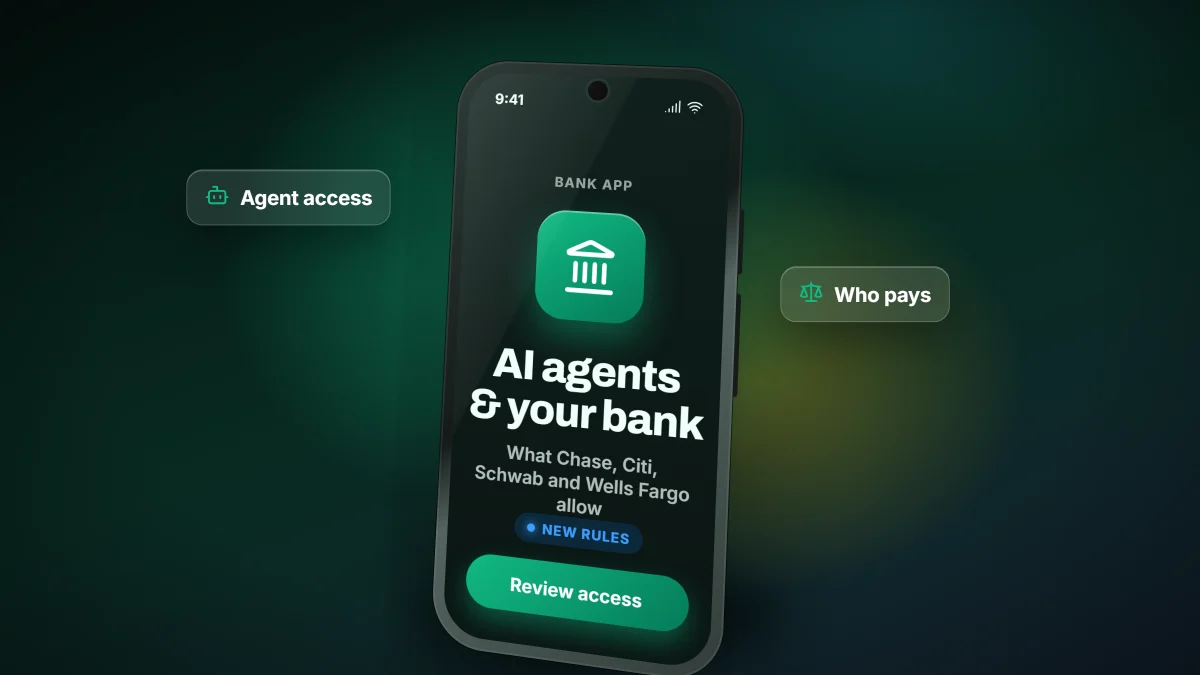
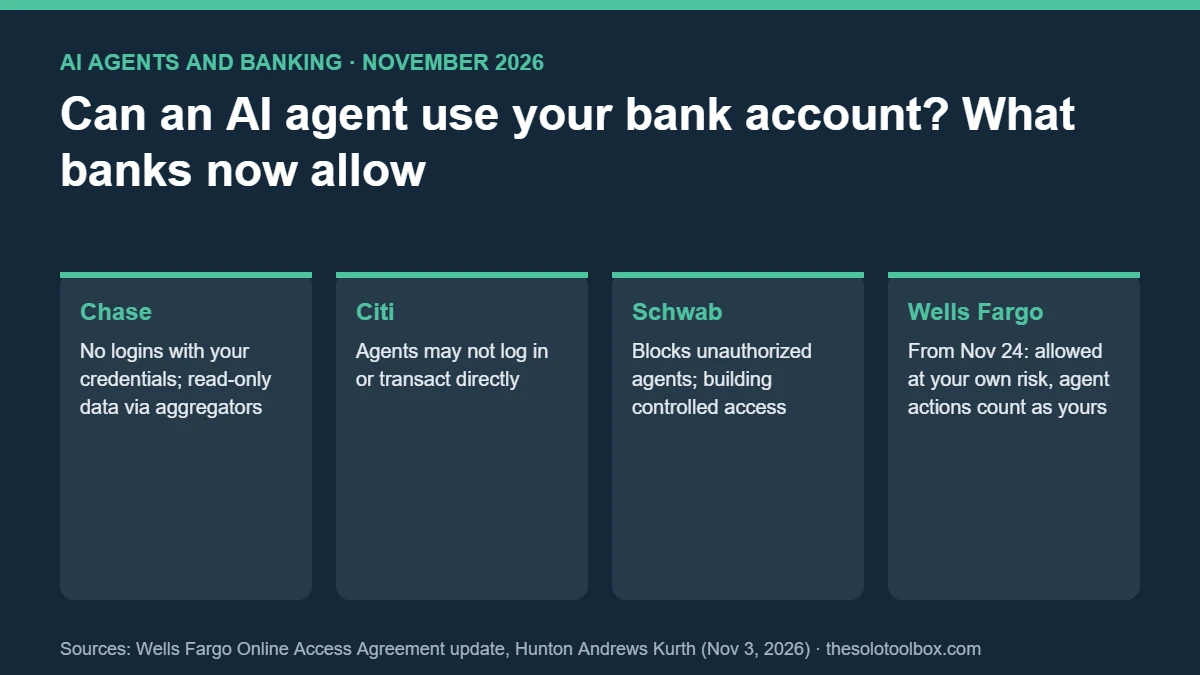
At most big US banks, an AI agent is not allowed to log in to your account with your username and password. Chase, Citi and Charles Schwab have said they block third-party AI agents that sign in or move money on a customer’s behalf. Wells Fargo is taking a different route: from November 24, 2026, its updated Online Access Agreement lets you use an AI agent “at your own risk” and treats what the agent does as authorized by you. Read-only connections for budgeting apps, such as those that go through Plaid, are still allowed at the banks that have explained their policies.
This guide covers what each bank has said, what Wells Fargo’s new AI agent section means if a bot makes a mistake, and what to check before connecting any AI assistant to your money.
Before you start
- Applies to: US customers of Chase, Citi, Charles Schwab and Wells Fargo. Other banks’ terms vary, so check your own bank’s online banking agreement.
- How we checked this: on November 22, 2026 we read Wells Fargo’s notice about its updated Online Access Agreement and the upcoming agreement, a November 3 analysis by law firm Hunton Andrews Kurth, American Banker’s November 2 report, and October coverage on Yahoo Finance and Yahoo Tech based on Axios reporting. Chase, Citi and Schwab positions come from earnings calls and spokesperson statements as reported; we couldn’t read their full terms. We read Wells Fargo’s AI section through automated text extraction, so check the agreement itself before relying on exact wording.
- Not legal advice: this explains published terms. For a dispute, talk to your bank or a consumer attorney.
Why banks are acting now
Consumer AI agents can now sign in to websites and click through tasks for you. Meta’s Muse, launched in September 2026, is the one bank executives keep naming. Banks say they can’t reliably tell an agent from the customer at login, and that agents are already trying to move money. Schwab CEO Rick Wurster told Bloomberg in October that agents were attempting to move client money 10 to 20 times a week. JPMorgan CEO Jamie Dimon raised “rogue agents” on the bank’s October 13 earnings call.
The legal backdrop is unsettled. The CFPB’s open banking rule (Section 1033), which would have set rules for sharing account data with third parties, is blocked by a federal court and under reconsideration, so there is no federal rule yet on how agents should connect.
What each bank has said
| Bank | Position on third-party AI agents | Read-only data for budgeting apps |
|---|---|---|
| JPMorgan Chase | Third parties may not use customer credentials to log in for the customer. Hunton reports an updated Digital Services Agreement, effective January 1, 2027, that treats an agent’s actions as authorized by you if you gave it access | Allowed through aggregators such as Plaid; no payments or transfers |
| Citi | Third-party AI agents may not log in to customer accounts or transact on its digital banking platforms | Limited read-only access through some open banking providers |
| Charles Schwab | Blocks unauthorized agents; building controlled connections that share information without moving money; offers its own assistant, Charley | Planned through controlled connections |
| Wells Fargo | Allows agents from November 24, 2026, at your own risk; agent actions are treated as yours; the bank can limit or block agents | Not addressed in the sources we read |
| Morgan Stanley, Bank of America | Reported by Axios to be blocking or tightening restrictions; we found no published terms | Unknown |
What Wells Fargo’s new AI agent section says
The upcoming agreement adds Section 15, “Third-Party Artificial Intelligence Agents or Agentic AI”, and mentions AI agents in several other sections. The main points:
- Broad definition. An AI agent is any software that acts for you, whether autonomously, semi-autonomously or not autonomously at all.
- Agent actions count as yours. If you give an agent your login or otherwise authorize it, its transactions are treated as initiated and authorized by you, without further verification.
- No monitoring by the bank. Wells Fargo says it doesn’t monitor, screen or review agent activity, or vouch for an agent’s security.
- Revocation is on you. You must revoke an agent’s access properly, keep proof that you did, and provide it if the bank asks. American Banker reported that Wells Fargo appears to be the first bank to require proof of revocation.
- The bank can shut agents out. It may require agents to be registered, restrict what they can do, or cut off their access.
- Wires carry extra warnings. The notice says letting an agent or other third party access online banking may weaken the security procedures for digital wires, and you accept that risk.
- Privacy follows the AI provider. Information you share with a third-party AI tool is governed by that provider’s privacy policy and terms, not Wells Fargo’s.
What this means if an agent makes a mistake
Suppose an agent pays the wrong biller, or a malicious web page tricks it into sending money to a scammer. Under Wells Fargo’s terms, that transfer is treated as yours. The federal rule that limits your losses on unauthorized electronic transfers, Regulation E, generally doesn’t treat a transfer as unauthorized when it’s made by someone you gave access to, until you tell the bank that access is no longer authorized. No regulator has issued guidance on how this applies to AI agents that we could find, so expect disputes to be messy.
Prompt injection, where hidden text on a page gives an AI agent new instructions, is one way this happens. We covered a version of it in our report on the AGENTS.md downloads folder attack.
Before you connect an AI assistant to your bank
- Don’t give an agent your banking password. At Chase and Citi it breaks their rules. At Wells Fargo it makes you responsible for whatever the agent does.
- Use read-only connections for budgeting. Apps that connect through an aggregator with your bank’s approval can see balances and transactions without being able to move money.
- Use your bank’s own tools for account questions. Schwab’s Charley is one example; most banks’ apps have a built-in assistant or search.
- Review connected apps. In your bank’s security or data-sharing settings, look for the list of connected apps and services and remove anything you no longer use.
- Turn on alerts for transfers and new payees, so you see unexpected payments within minutes rather than at the end of the month.
If you’ve already given an agent your login
- Change your online banking password and sign out of other sessions in your bank’s security settings.
- Revoke the agent’s access in the agent’s own settings, and delete any saved credentials there. Our guide to logging out of ChatGPT and Claude on all devices shows where session controls live in two common assistants.
- If you bank with Wells Fargo, keep a dated record of the revocation, such as a screenshot, and tell the bank that the agent is no longer authorized.
- Add a stronger sign-in method. Our guide to setting up passkeys covers Google and Microsoft accounts; many bank apps now offer passkeys too.
Frequently asked questions
Is it illegal to let an AI agent log in to my bank account?
It isn’t a crime, but at Chase and Citi it’s against the banks’ rules, and banks can restrict accounts that break their terms. Check your bank’s online access agreement for “AI” or “agent”.
Can I still use budgeting apps connected through Plaid?
Yes, based on Chase’s and Citi’s statements, read-only data sharing through approved aggregators is still allowed. Those connections can’t move money.
When does the Wells Fargo change take effect?
November 24, 2026. Wells Fargo has posted a notice about the updated agreement on its website; the notice explains how the new terms apply to your account.
Who pays if an AI agent sends my money to a scammer?
At Wells Fargo, the new terms say you’re responsible for transactions your agent makes. At other banks, the question hasn’t been settled publicly, which is one reason they are blocking agents instead.
What to do next
Open your bank’s online banking agreement and search it for “agent” or “artificial intelligence”. If it says nothing, assume that sharing your password with any tool, AI or not, breaks your terms, and keep AI assistants to read-only connections until your bank offers an approved way to connect them.
Sources
- Wells Fargo: We Are Updating Our Online Access Agreement
- Wells Fargo: Online Access Agreement, version effective November 24, 2026
- Hunton Andrews Kurth: Major Banks Move to Block or Limit Customer-Directed AI Agents (November 3, 2026)
- American Banker: Wells Fargo wants customers to prove they’ve revoked AI agents (November 2, 2026)
- Yahoo Finance: Major U.S. Banks Block AI Agents Found in Customer Accounts (October 26, 2026)
- Yahoo Tech: Your bank can’t tell if it’s you or an AI agent trying to log into your account (October 23, 2026)
- CFPB: Regulation E, 12 CFR 1005.2 definitions
Last checked: November 22, 2026. If something here is out of date, let us know.