Rackspace Spot Shutting Down: What to Do Before December 8
The Solo Toolbox · Software Help for One-Person Businesses
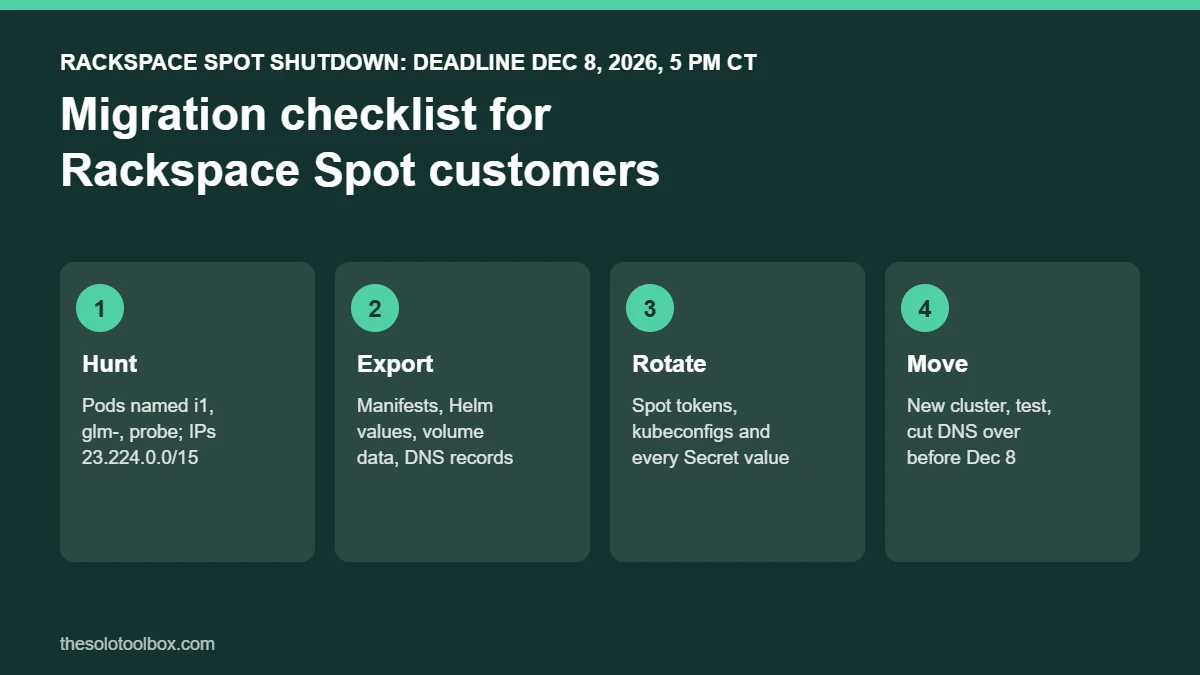
Rackspace is shutting down Rackspace Spot, its low-cost managed Kubernetes platform, on December 8, 2026 at 5 PM Central Time (23:00 UTC). After that, remaining workloads are terminated and data can’t be retrieved. The shutdown follows a November 17 breach in which attackers used compromised credentials to create pods in customer clusters and read Kubernetes Secrets, so moving off Spot isn’t enough: every credential that ever lived in those clusters needs replacing.
This guide gives the timeline, the attacker indicators Rackspace shared, and an order of work for checking, exporting and moving your workloads with about two weeks to go.
Before you start
- Who this is for: developers, small SaaS teams and agencies running workloads on Rackspace Spot.
- What you need:
kubectlaccess to each Spot cluster, your Helm charts or manifests, and an account with the provider you’re moving to. - How we checked this: on November 24, 2026 we read BleepingComputer’s report on the shutdown, which quotes the customer security notification Rackspace sent. We have not seen the notice ourselves and could not verify Spot console menu names. The
kubectl, Helm and Velero commands below are standard and work on any conformant cluster.
What happened: the Rackspace Spot timeline
| Date (2026) | Event |
|---|---|
| November 16 | Earliest date Rackspace asks customers to review access logs from |
| November 17 | Attackers get into the Spot platform with compromised credentials |
| November 18 | Rackspace finds the intrusion after a customer report and disables the admin console |
| November 21 | Service restored after an extended outage |
| November 24 | Rackspace tells customers it will wind down Spot |
| December 8, 5 PM CT | Spot permanently discontinued; workloads terminated, data inaccessible |
Rackspace says the attackers could create unauthorized pods in customer clusters, read Kubernetes Secrets and list nodes and volumes, and “may have read cluster Secrets and files on storage volumes.” It says Spot is segmented from the rest of Rackspace and it has found no evidence of access to its core systems.
Step 1: Look for the attacker’s pods and IPs
Rackspace shared three indicators: the IP address 23.224.79.106, the range 23.224.0.0/15 (which covers 23.224.x.x and 23.225.x.x), and Kubernetes pods or objects whose names start with i1, glm- or probe. Run these against every Spot cluster:
# Pods whose names start with the reported prefixes
kubectl get pods -A --no-headers | awk '$2 ~ /^(i1|glm-|probe)/'

# Workload objects with the same prefixes
kubectl get deploy,ds,sts,job,cronjob -A --no-headers | awk '$2 ~ /\/(i1|glm-|probe)/'

# Newest pods last, to spot anything created since November 16
kubectl get pods -A --sort-by=.metadata.creationTimestamp
A match isn’t automatic proof. Plenty of legitimate tools name things probe-something, so check the image, creation time and owner of each hit with kubectl describe pod NAME -n NAMESPACE. Kubernetes events usually expire after an hour, so don’t expect kubectl get events to show activity from last week.
Then search your own ingress, load balancer and application logs from November 16 onward for the IP range:
grep -E '23\.22[45]\.' /path/to/access.logIf you find attacker objects, save their YAML with kubectl get pod NAME -n NAMESPACE -o yaml before deleting them, in case you need it for an incident report.
Step 2: Rotate every secret, not only the Spot ones
Rackspace tells all Spot customers to treat their API tokens, refresh tokens, kubeconfigs and Kubernetes Secrets as potentially compromised, even if they never got a breach notice. The Secrets matter most, because they usually hold credentials for systems outside Spot. List them:
kubectl get secrets -AThen change each value at its source, in this order:
- Cloud and payment keys (AWS, GCP, Azure, Stripe and similar): create new keys in the provider’s console, deploy them, then delete the old ones.
- Database passwords: change the password on the database server itself. Recreating the Kubernetes Secret with the old value does nothing.
- Third-party API tokens for email, SMS, AI providers, monitoring and Git hosting.
- Container registry pull secrets and any deploy keys.
- TLS private keys: if a certificate’s key sat in a Secret, reissue the certificate with a new key.
- Spot API tokens, refresh tokens and kubeconfigs: revoke them in the Spot console and delete local kubeconfig copies once you’ve moved.
We covered the same rotation order after the Northflank breach; that guide has more detail on revoking keys without downtime.
Step 3: Export everything you need from Spot
If your manifests and Helm charts live in Git, you mostly need values and data. If the cluster is your only copy, export it now:
# Helm releases and their values
helm list -A
helm get values RELEASE -n NAMESPACE > RELEASE-values.yaml

# Manifests per namespace (Secrets left out on purpose)
for ns in $(kubectl get ns -o jsonpath='{.items[*].metadata.name}'); do
  kubectl get deploy,sts,ds,svc,cm,ingress,cronjob,pvc -n "$ns" -o yaml > "backup-$ns.yaml"
done
Exported YAML includes cluster-specific fields such as uid, resourceVersion and status. Strip them before applying to the new cluster. Don’t export Secrets to reuse: you are replacing those values in step 2.
For data on persistent volumes, use the application’s own export where one exists, which gives you a consistent copy:
# PostgreSQL example
kubectl exec -n NAMESPACE POD -- pg_dump -U USER DATABASE > database.sql

# Copy files out of a pod
kubectl cp NAMESPACE/POD:/data ./data-backup
For many volumes, Velero can back up a whole cluster, volumes included, to object storage you control (velero backup create spot-final --default-volumes-to-fs-backup). Test a restore before December 8, not after.
Step 4: Pick where to move
Spot was popular because it priced nodes by auction. If cost is the reason you were there, look for spot or preemptible node pools elsewhere:
| Option | What it suits | Spot-style pricing |
|---|---|---|
| Amazon EKS | Teams already on AWS | EC2 Spot Instances in node groups |
| Google GKE | Teams already on Google Cloud | Spot VMs in node pools |
| Azure AKS | Microsoft-heavy stacks | Spot node pools |
| DigitalOcean, Akamai (Linode), Vultr, Civo, Scaleway, OVHcloud | Small teams wanting simple managed Kubernetes | Varies by provider; check current pricing pages |
| A single VM running k3s | Hobby projects and small internal tools | Depends on the VM provider |
Check each provider’s current pricing yourself; we haven’t compared rates for this guide. Whichever you choose, create the new cluster this week so you have time to test.
Step 5: Cut over before the deadline
- Apply your cleaned manifests or Helm charts to the new cluster with the new secret values.
- Restore volume data and run your app’s smoke tests.
- Lower DNS TTLs a day ahead, then point DNS at the new load balancer.
- Watch logs for 24 hours, then delete the Spot workloads and revoke the remaining Spot tokens yourself rather than waiting for Rackspace to terminate them.
If you went through the Zeabur shutdown earlier this month, the order is the same: secrets first, data second, DNS last.
FAQ
When exactly does Rackspace Spot shut down?
December 8, 2026 at 5 PM Central Time, which is 23:00 UTC. Rackspace says remaining workloads will be terminated then and customer data will no longer be accessible.
Will Rackspace extend the deadline?
Rackspace has not said it will reconsider the shutdown or give more time, even though customers on Reddit have asked. Plan for December 8.
Were other Rackspace services affected?
Rackspace says the Spot environment is segmented from its core infrastructure and it has found no evidence of access to its core systems or other customers’ environments.
Do I need to rotate secrets if I never got a breach notice?
Yes. Rackspace is telling all Spot customers to treat API tokens, refresh tokens, kubeconfigs and Kubernetes Secrets as potentially compromised, whether or not they received an earlier notification.
What to do next
Run the step 1 checks today and start the secret rotation in step 2 before anything else; the migration can follow over the next week. Put December 8, 5 PM CT in your calendar with a reminder two days earlier.
Related guides
Sources
- BleepingComputer: Rackspace shuts down Spot cloud platform after security breach (November 24, 2026)
- Kubernetes documentation: kubectl reference
- Velero documentation
Last checked: November 24, 2026. If something here is out of date, let us know.