Digital Duty of Care Act: What Changes for Australian Users
The Solo Toolbox · Software Help for One-Person Businesses
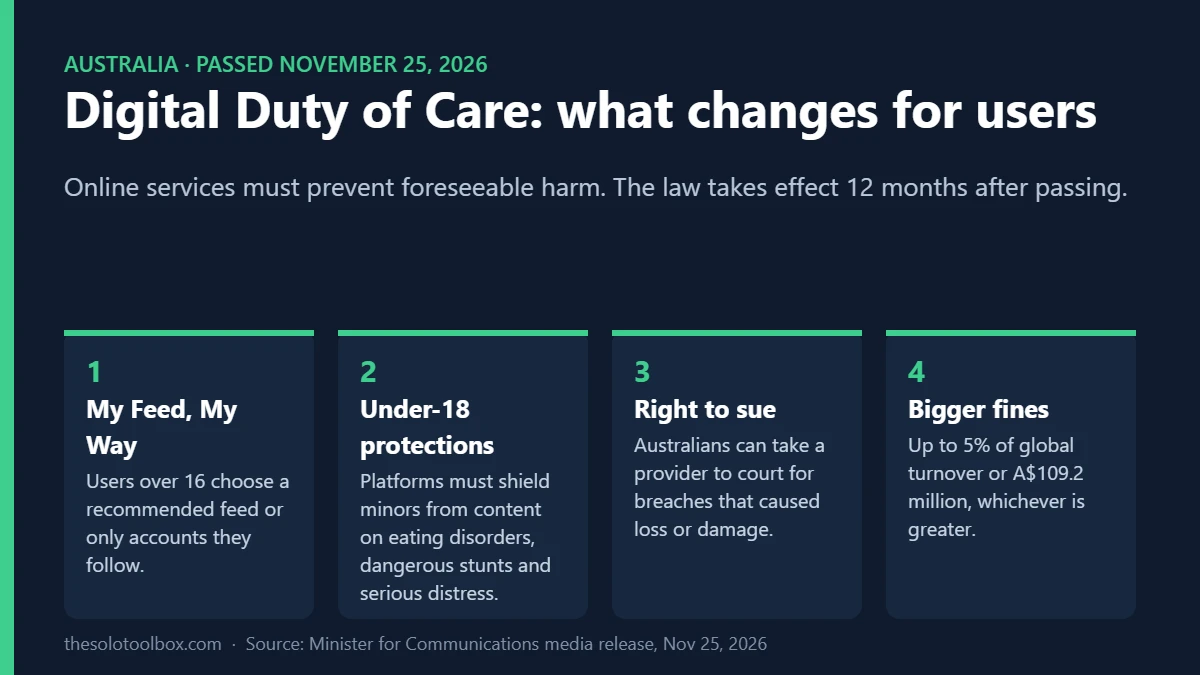
Australia’s Parliament passed the Digital Duty of Care law on Wednesday, November 25, 2026. It requires online services, including social media, games, apps and AI chatbots, to protect users from seriously harmful material and from features that cause harm, with fines of up to 5% of global turnover or A$109.2 million, whichever is greater. The government says it takes effect in 12 months, so nothing changes on your phone yet.
For people who use these services in Australia, three changes stand out: a right to switch off recommendation algorithms, called My Feed, My Way; new duties to protect under-18s; and the ability to sue a platform directly. Here is what each one does, who is covered, what critics say, and what is still unknown.
Before you start
- Who this is for: people in Australia who use social media, games, apps or AI chatbots, parents of Australian teens, and anyone outside Australia watching whether similar rules spread.
- Status: passed by Parliament on November 25, 2026. The government says it comes into effect in 12 months. No exact start date had been published when we checked.
- How we checked this: on November 26, 2026 we read Communications Minister Anika Wells’s media releases from October 15 and November 25, 2026, plus reporting from TIME and The Record. We have not read the final text of the Act, and the detailed rules, including the one for My Feed, My Way, are still being written.
What the Digital Duty of Care Act is
The law began as the Online Safety Amendment (Digital Duty of Care) Bill 2026, introduced on October 15. It amends Australia’s Online Safety Act 2021. According to TIME, it replaces the industry-written online safety codes with a broad legal duty after a 12-month transition, the same model Australia uses for workplace safety: providers must manage risks to users as far as is reasonably practicable.
Under the law, platforms must give regulators written risk assessments at least once a year and tell regulators before making major design changes that could create new harms. TIME’s example is “addictive” features; The Record cites endless scrolling.
What changes for users
| Change | What the law does | Who it affects |
|---|---|---|
| My Feed, My Way | Social media services must let users choose recommended content or only the pages and people they follow as their main feed | Users over 16 in Australia |
| Protections for under-18s | Platforms must protect minors from material, conduct and features harmful to them, including content glorifying crime or life-endangering stunts, causing serious mental distress, encouraging eating disorders or promoting hostile attitudes towards women | Under-18s |
| Right to sue | Individuals or groups can take a provider to court for breaches of the duty that caused them loss or damage | All users in Australia |
| Faster eSafety action | eSafety gets powers to remove nudify apps and sites; required response time for cyberbullying and abuse complaints drops from 48 to 24 hours | Victims of image abuse and bullying |
| Complaint handling | A rule-making power to set up an external dispute resolution pathway and minimum standards for platform complaints | Anyone reporting harm |
The Record also reports that the law requires age verification to access pornography.
How My Feed, My Way will work
The minister’s October release says Australians over 16 will be able to choose whether their primary feed shows recommended content or only the pages and people they follow. The detailed rule went to public consultation through the Department of Infrastructure’s “choice of feeds” consultation page. Exactly how apps present the choice, and whether it applies to every service, depends on that final rule.
Which services are covered
The government’s releases name “games, apps, social media platforms and AI chatbots.” That includes AI companion apps, the category at the centre of this week’s child-safety reporting about chatbots. Wells said in October that the law would also apply to Truth Social. The October release says professional news material and entertainment media are exempt, and that Parliament must scrutinise any additional harms added later.
Fines and enforcement
The bill introduced in October set a maximum penalty of A$109.2 million. The final law raises it to 5% of a company’s global turnover or A$109.2 million, whichever is greater, a change Wells said the Australian public demanded, according to TIME. The eSafety Commissioner enforces Australia’s online safety laws, and the new private right of action adds a second route: people harmed can go to court themselves.
What critics say
- US government: US Ambassador David Brat said “vaguely defined ‘harms'” backed by 5% penalties will push platforms to censor lawful speech, TIME reports. US embassies had earlier objected to rules forcing chronological feeds.
- Industry: the Tech Council of Australia, whose members include Google and Microsoft, said it supports the legislation but called the private right of action “a complex undertaking with significant consequences.”
- Opposition: Senator Sarah Henderson called it “a blank cheque for political censorship.” Wells responded that the law is about “what the platforms do or fail to do online,” not what users say.
What it means if you live outside Australia
Directly, nothing: the duty applies to services used by Australians. Indirectly, it’s unclear. Platforms could limit new features such as feed choice to Australian accounts or roll them out more widely; none has said which yet. The UK and EU already have duty-of-care style rules, and a US bill along similar lines has stalled in Congress, according to The Record.
What you can do now
- Nothing changes yet. The government says the duty applies in 12 months and hasn’t given an exact date.
- Report harm today through eSafety, which already handles cyberbullying, image-based abuse and illegal content complaints.
- Use the controls apps already offer. Many apps have a following-only or chronological view and teen supervision tools; see our guide to Pinterest’s controls for AI content for one example.
Frequently asked questions
When does the Digital Duty of Care start?
The government says it comes into effect 12 months after becoming law. Parliament passed it on November 25, 2026, so expect it around late 2027. No exact date had been published as of November 26, 2026.
What is My Feed, My Way?
It’s the part of the law that lets Australians over 16 choose whether their main social media feed shows recommended content or only accounts they follow. The detailed rule is still being finalised after public consultation.
Can I sue a social media company under the Digital Duty of Care?
Yes, once it’s in force. The law creates a private right of action, so individuals or groups can take a provider to court for breaches of the duty that caused them loss or damage.
Does the Digital Duty of Care apply to AI chatbots?
Yes. The government’s November 25 release lists AI chatbots alongside games, apps and social media platforms as services that must protect users from harm.
How big are the fines?
Up to 5% of the company’s global turnover or A$109.2 million, whichever is greater.
What to do next
If you’re a parent, the duty won’t help for another year, so check the controls on your child’s apps now. Our guide to the New York AI toy ban covers a similar move in the US, and if a nude or sexual image of you has been faked, follow our steps to remove sexual deepfakes.
Related guides
Sources
- Minister for Communications: Australia’s Digital Duty of Care becomes law (November 25, 2026)
- Minister for Communications: Digital Duty of Care next step in Australia’s world-leading reforms (October 15, 2026)
- TIME: What Australia’s ‘Digital Duty of Care’ law means for Big Tech (November 25, 2026)
- The Record: Australia passes tough legislation requiring big tech to preempt foreseeable harms (November 25, 2026)
- Department of Infrastructure: Choice of feeds on social media consultation
Last checked: November 26, 2026. If something here is out of date, let us know.