How to Remove Sexual Deepfakes of You: 5 Steps That Work
The Solo Toolbox · Software Help for One-Person Businesses
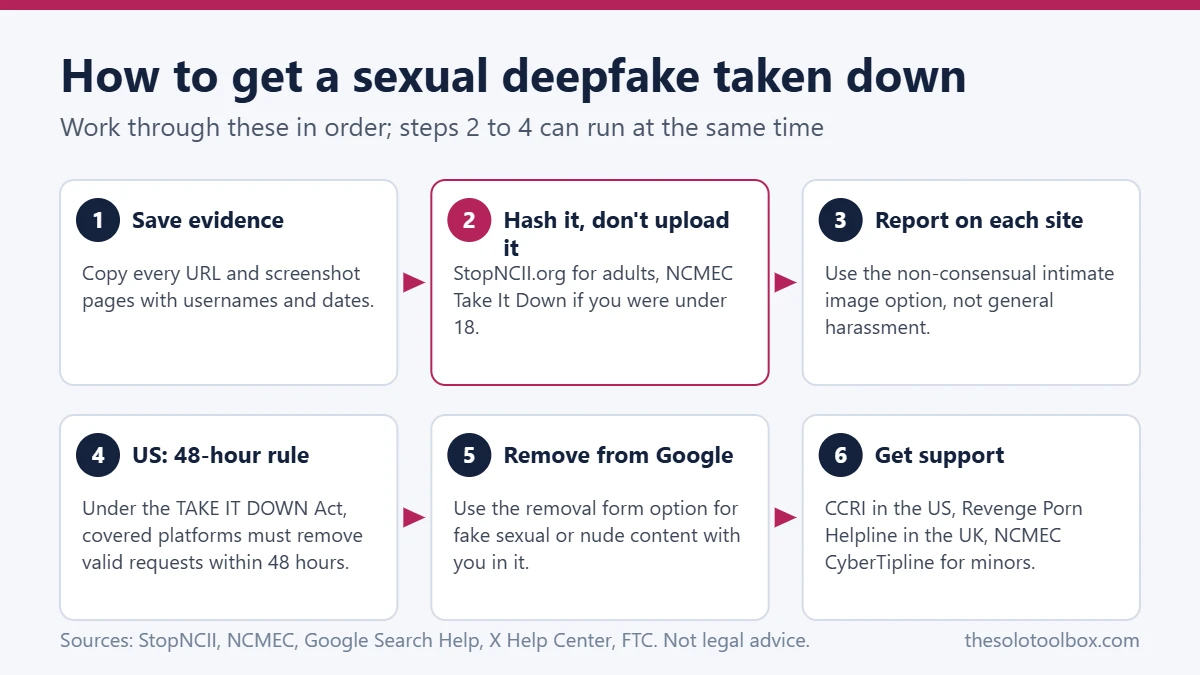
If someone made a sexual deepfake of you, you can get it taken down without sharing the image with anyone: create a hash with StopNCII.org (adults) or NCMEC’s Take It Down (images made when you were under 18), report it to each site it’s on, and ask Google to drop it from Search. In the US, the TAKE IT DOWN Act now requires covered platforms to remove reported intimate images, including AI fakes, within 48 hours of a valid request.
The issue is in the news again after Virginia and Oregon sued SpaceX on November 23, 2026 over sexual images created with its Grok chatbot. Below: what the lawsuits claim, then the removal steps in the order that works best.
Before you start
- Who this is for: anyone whose face or body has been used in a fake nude or sexual image or video, and anyone helping them.
- Before anything else: save evidence (see step 1), but don’t forward the image to friends or repost it to ask for help. If the image shows someone under 18, don’t keep or share a copy at all; report it to NCMEC’s CyberTipline.
- How we checked this: on November 24, 2026 we read the StopNCII and Take It Down (NCMEC) how-it-works pages, Google’s Search help page for removing fake sexual content, X’s intimate media policy (updated August 2026) and Tech Times’ report on the lawsuits. We couldn’t read the bill text on congress.gov, so the TAKE IT DOWN Act details come from the law as signed in May 2025 and the FTC’s reporting page. This is not legal advice.
What Virginia and Oregon are suing over
Virginia Attorney General Jay Jones and Oregon Attorney General Dan Rayfield filed suits on Monday, November 23, 2026, against SpaceX, X and SpaceX Super Intelligence, the unit formerly known as xAI. According to Tech Times, the states allege that:
- Grok Imagine’s “Spicy” mode, launched in July 2025, allowed nude images, and Grok’s image editing could “undress” photos of real people.
- The companies told users Grok and X were safe, with strong safeguards and “zero tolerance” for this content, while removing standard protections.
- Grok still produces non-consensual sexual images, including of children, and coaches users on getting around moderation.
Oregon is suing under its Unlawful Trade Practices Act and Virginia under its Consumer Protection Act. The states want civil penalties, restitution for victims and a court order barring SpaceX from profiting from Grok’s “nudification” features. Tech Times reported that SpaceX has previously pointed to 52,222 suspended accounts and 73,604 reports to NCMEC in 2026; we found no direct company response to these suits.
None of this changes what you can do today. The tools below work regardless of which app made the image.
Step 1: Save evidence first
Before reporting, record where the content is. Platforms can delete it and accounts can vanish, and you may need proof for police, a lawyer or a later takedown.
- Copy the full URL of every post, profile and page that shows the image.
- Screenshot each page with the username, date and any messages or threats visible. Don’t screenshot the image on its own if you can avoid it.
- Note who you think made or shared it and how you found out.
- If someone is threatening to post more unless you pay or send images, that’s sextortion. Don’t pay or reply; save the messages and report the account.
Step 2: Hash it with StopNCII or Take It Down
Both services stop the image spreading across many big platforms at once, and neither one sees the image itself. Your phone or computer turns the file into a hash, a string of characters that works like a digital fingerprint, and only that hash is sent. Participating platforms then look for matching content and remove it under their own rules.
| StopNCII.org | Take It Down (NCMEC) | |
|---|---|---|
| For | Adults: you were 18+ in the image and are 18+ now | Images or videos taken when you were under 18 |
| Run by | Revenge Porn Helpline (SWGfL) | National Center for Missing & Exploited Children |
| Do you upload the image? | No, only a hash | No, only a hash |
| Cost | Free | Free and anonymous |
| You’ll need | The file on your device | The file on your device |
StopNCII: go to StopNCII.org, select Create Your Case, confirm you’re eligible and choose the files on your device. You get a case number and PIN; write them down, because they can’t be recovered. You can use Check Case Status later or withdraw the case.
Take It Down: go to takeitdown.ncmec.org, select Get Started and choose the file. It works for anyone who was under 18 in the image, even if they’re an adult now. NCMEC says not to repost the content to make a report.
The limit: these hashes only reach platforms that have signed up, and edited or cropped copies may not match. That’s why steps 3 and 4 still matter.
Step 3: Report it on each site it’s on
Report every copy you found in step 1. On X, open the post, select Report post, then Private or Non-Consensual Content, and pick the option about sharing a sexual, nude or intimate image of you without permission. X’s policy, updated in August 2026, explicitly covers AI-generated and deepfake images of real adults. On desktop you can also use X’s private information report form.
Most large platforms, including Instagram, Facebook, TikTok, Reddit and Discord, have a similar non-consensual intimate imagery option in their report menu. Pick that option rather than general harassment, so the report is judged under the right policy.
In the US, the TAKE IT DOWN Act, signed in May 2025, requires covered platforms to have had a removal process in place since May 19, 2026. Once they get a valid request, they must take the image down within 48 hours and make reasonable efforts to remove known copies. A valid request generally needs your signature, where the image is, and a short statement that it was shared without your consent. If a platform ignores you, you can report it to the FTC at takeitdown.ftc.gov.
Step 4: Remove it from Google Search
Even when a site won’t cooperate, you can stop the page appearing in Google results:
- Open Google’s content removal form and select Start removal request.
- Choose the option to remove fake sexual or nude content with you in it.
- Paste the URLs of the pages and images. Google asks you to confirm you’re identifiable, the content is fake and was shared without consent.
- Leave duplicate removal switched on so Google also filters copies it finds.
This removes results from Google Search only. The page stays online until the site itself deletes it, so keep step 3 going in parallel.
Step 5: Get help if it’s more than one post
If the image is spreading, someone is threatening you, or you’re in school or at work with the person who did it, get support:
- US: the Cyber Civil Rights Initiative (cybercivilrights.org) runs a free helpline and keeps a list of state laws. You can also report to the FBI’s IC3 if you’re being extorted.
- UK: the Revenge Porn Helpline, which runs StopNCII, helps adults with takedowns.
- Under 18: report to NCMEC’s CyberTipline and tell a trusted adult. In most places, creating or sharing such an image of a minor is a crime even if it’s fake.
Make future fakes harder
You can’t fully stop someone using public photos, but you can limit how much material is easy to grab. Set personal accounts to private, remove old public photos you don’t need, and check which apps can read your camera roll; our guide to stopping Facebook accessing your photo gallery walks through one common example. If an account was hacked to get photos, follow our infostealer checklist to lock it down.
FAQ
Is it illegal to make a sexual deepfake of someone?
In the US, the TAKE IT DOWN Act makes it a federal crime to knowingly publish non-consensual intimate images, including AI-generated ones, and many states have their own laws. Rules vary by country, so check locally or ask a lawyer.
Do I have to upload the image to StopNCII or Take It Down?
No. Both create a hash on your own device and send only that. The image itself never leaves your phone or computer.
Can I tell if an image of me is AI-generated?
Sometimes. Google’s SynthID can show whether some images were made or edited with Google AI tools; see our guide to checking SynthID on iPhone. For a takedown, you don’t need to prove it’s fake: the removal rules cover both real and fake intimate images shared without consent.
What if the site is hosted outside the US?
Report it to the site anyway and use Google’s removal form to cut it from Search. StopNCII hashes also work for participating platforms worldwide.
What to do next
Start with evidence, then submit a StopNCII or Take It Down case today; it takes a few minutes and covers many platforms at once. Then work through each site and Google’s form, and keep a simple list of what you reported and when, so you can follow up after 48 hours.
Related guides
Sources
- Tech Times: Virginia, Oregon sue SpaceX over Grok sexual images, allege safety claims were false (November 23, 2026)
- StopNCII.org: How it works
- NCMEC: Take It Down
- Google Search Help: Remove non-consensual explicit or intimate personal images
- X Help Center: Non-consensual nudity policy
- FTC: Report TAKE IT DOWN Act violations
Last checked: November 24, 2026. If something here is out of date, let us know.