How to Freeze Your Credit at All Four Bureaus for Free
The Solo Toolbox · Software Help for One-Person Businesses
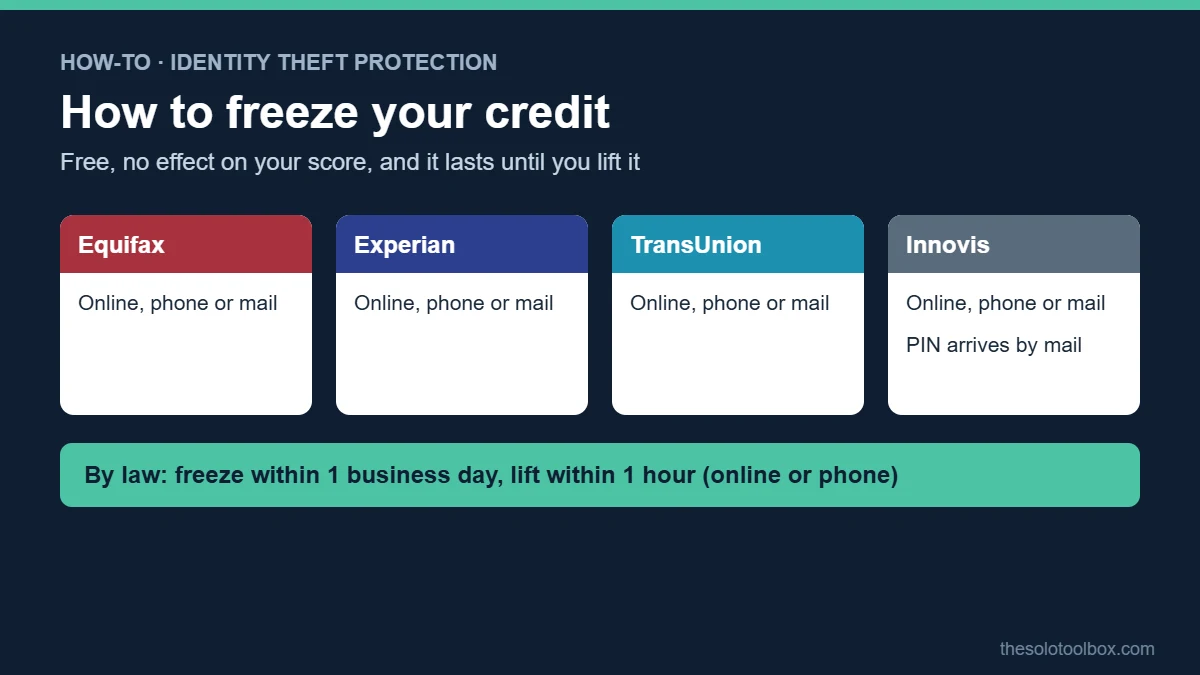
To freeze your credit, contact each credit bureau separately, Equifax, Experian, TransUnion and Innovis, and request a security freeze online, by phone or by mail. It’s free, it doesn’t affect your score, and while it’s in place nobody, including you, can open a new credit account in your name. You lift it temporarily when you need a loan, card or apartment.
This week’s breaches at myColorado, 1Password and Deichmann are a good prompt, but the FTC says you don’t have to wait for a breach. This guide covers where to freeze, how long each step takes by law, how to lift a freeze, and how a freeze differs from a lock or a fraud alert.
Before you start
- Who this is for: anyone with a US credit file. A freeze is most useful after your Social Security number, ID documents or address history have been exposed.
- What you need: your Social Security number, date of birth, current and recent addresses, an email address and a phone you can receive codes on.
- How we checked this: on November 26, 2026 we read the FTC’s guide to credit freezes and fraud alerts, USAGov’s credit freeze page and each bureau’s freeze page. Bureau sign-up screens change often, so labels may differ slightly from what you see.
Where to freeze your credit
There is no single switch. A freeze at one bureau does nothing at the others, so place one at each. Here is where to go:
| Bureau | Freeze page | How you can request it |
|---|---|---|
| Equifax | equifax.com credit freeze page | Online through a myEquifax account, by phone or by mail |
| Experian | experian.com credit freeze page | Online, by phone or by mail |
| TransUnion | transunion.com/credit-freeze | Online, by phone or by mail |
| Innovis | innovis.com security freeze page | Online form, phone 1-866-712-4546, or mail form |
Use the bureau’s own site. Type the address yourself or use the links above rather than clicking a link in a breach notice or search ad, because fake freeze pages are an easy way to collect Social Security numbers.
How to freeze your credit, step by step
The screens differ, but each bureau follows the same pattern:
- Open the bureau’s freeze page and choose the option to place or add a security freeze.
- Create an account or fill in the request form with your name, Social Security number, date of birth and address.
- Answer the identity questions. These often ask about past addresses, loans or phone numbers tied to your file.
- Confirm the freeze and save the confirmation. Innovis mails a confirmation letter with a 10-digit Security Freeze PIN; keep it somewhere safe, because you may need it to lift the freeze.
- Repeat for the other three bureaus.
If a bureau can’t verify you online, it will offer phone or mail instead. Mailed requests take longer, so do these first if you have upcoming travel or a credit application.
How long a freeze takes
Federal law sets deadlines for the bureaus, according to USAGov:
| Request | Online or by phone | By mail |
|---|---|---|
| Place a freeze | Within one business day | Within three business days |
| Lift a freeze | Within one hour | Within three business days |
How to lift a freeze when you need credit
Sign in to the same bureau account you used to freeze, or call or write to it, and choose a temporary lift for a set period or remove the freeze completely. The FTC suggests asking the lender which bureau it will check and lifting only that one, then putting the freeze back once the check is done.
Plan ahead for apartment applications, new phone contracts, car loans and some job or insurance checks. A lift requested online or by phone must take effect within an hour, so a same-day application is usually still possible.
Credit freeze vs lock vs fraud alert
| Option | What it does | Cost | How long |
|---|---|---|---|
| Credit freeze | Blocks access to your report for new credit until you lift it | Free by law | Until you lift it |
| Credit lock | Similar effect, usually run through a bureau’s app under its own terms | Varies by bureau and product | Depends on the product |
| Initial fraud alert | Tells lenders to verify your identity before opening credit; doesn’t block access | Free | One year, renewable |
| Extended fraud alert | Same as above, for confirmed identity theft victims with an FTC or police report | Free | Seven years |
You can have a freeze and a fraud alert at the same time. Unlike a freeze, a fraud alert only needs to be placed at one of Equifax, Experian or TransUnion; that bureau must tell the other two.
Who can still see your report while it’s frozen
A freeze doesn’t lock everyone out. According to Innovis, these can still access a frozen report: companies you already have accounts with, collection agencies working for those companies, credit monitoring services, and state, local and federal agencies where the law allows. That’s why a freeze stops new-account fraud but not misuse of accounts you already have.
Freezing a child’s credit
For a child under 16, a parent or guardian can request a free freeze, which stays in place until you remove it. The process is different from an adult freeze and usually needs proof of your identity and the child’s, such as a birth certificate. Each bureau’s freeze page links to its own instructions for minors.
Frequently asked questions
Does freezing your credit hurt your credit score?
No. The FTC says a credit freeze doesn’t affect your credit score, and it costs nothing to place or lift.
How long does a credit freeze last?
Until you lift it. There is no expiry date, so a freeze you place today stays in force until you contact the bureau to remove it or lift it temporarily.
Can I still check my own credit report with a freeze?
Yes. A freeze blocks lenders from pulling your report for new credit. You can still request your own reports, and companies you already have accounts with can still see your file.
Does a credit freeze stop fraud on my existing cards?
No. A freeze only blocks new accounts. Fraud on a card or bank account you already have is handled by that bank, so keep checking statements and use the number on the back of your card to report problems.
Do I need to freeze my credit at Innovis?
The FTC’s guidance names Equifax, Experian and TransUnion. Innovis is a smaller fourth bureau that some lenders use, and Colorado’s state IT office recommends freezing all four after the myColorado breach. Adding it closes a gap for little extra effort.
What to do next
Place the four freezes now and store any PINs or account logins in your password manager. If your freeze was prompted by a breach, check what else leaked with our guide on how to check whether your email was in a data breach, and if passwords were involved, follow our checklist for stolen passwords.
Related guides
Sources
- FTC Consumer Advice: Credit freezes and fraud alerts
- USAGov: How to place or lift a security freeze on your credit report
- Equifax: Security freeze
- Experian: Credit freeze
- TransUnion: Credit freeze
- Innovis: Add or manage a security freeze
- Colorado OIT: myColorado incident update recommending freezes at all four bureaus (November 25, 2026)
Last checked: November 26, 2026. If something here is out of date, let us know.