Claude text watermark: which models mark text and why it matters
Claude now hides an invisible watermark in the text it writes on most current models, including Opus 5.5, Sonnet 5.5, Haiku 5.5 and Mythos 5. You can’t see it and it doesn’t change the wording you read, but approved organizations can test a passage for it. Reports of Anthropic’s customer email put the switch-on for several older models at November 3, 2026.
This guide lists which models mark their output, where the mark applies, who can check for it, what removes it, and what it changes for people who use Claude for work.
Before you start
- Applies to: text from Claude apps, Claude Code, Cowork, Claude Tag and the Claude API, plus Claude models on AWS, Google Cloud and Microsoft Foundry
- Not covered: images and files, which use a separate Content Credentials (C2PA) label
- How we checked this: model list, surfaces and limits come from Anthropic’s help article How Claude marks AI-generated content, read November 4, 2026. The November 3 date comes from press reports of an Anthropic customer email, not from that article.
- Time to read: about 6 minutes
What changed on November 3
Anthropic began putting text watermarks in new models in August 2026, and models launched on or after August 2, 2026 carry them from day one. Its help article now says it is “adding watermarks to outputs from models released before August 2, 2026.” According to GIGAZINE and DEV Community, customers were emailed in late October that this would start on November 3, 2026.
Those reports name Mythos 5, Opus 4.7, Opus 4.6 and Sonnet 4.6. Anthropic’s own table, as of November 4, does not agree on one of them: it lists Opus 4.6 as carrying Content Credentials on files only, with no text watermark. We treat Anthropic’s table as the current answer.
Which Claude models watermark text
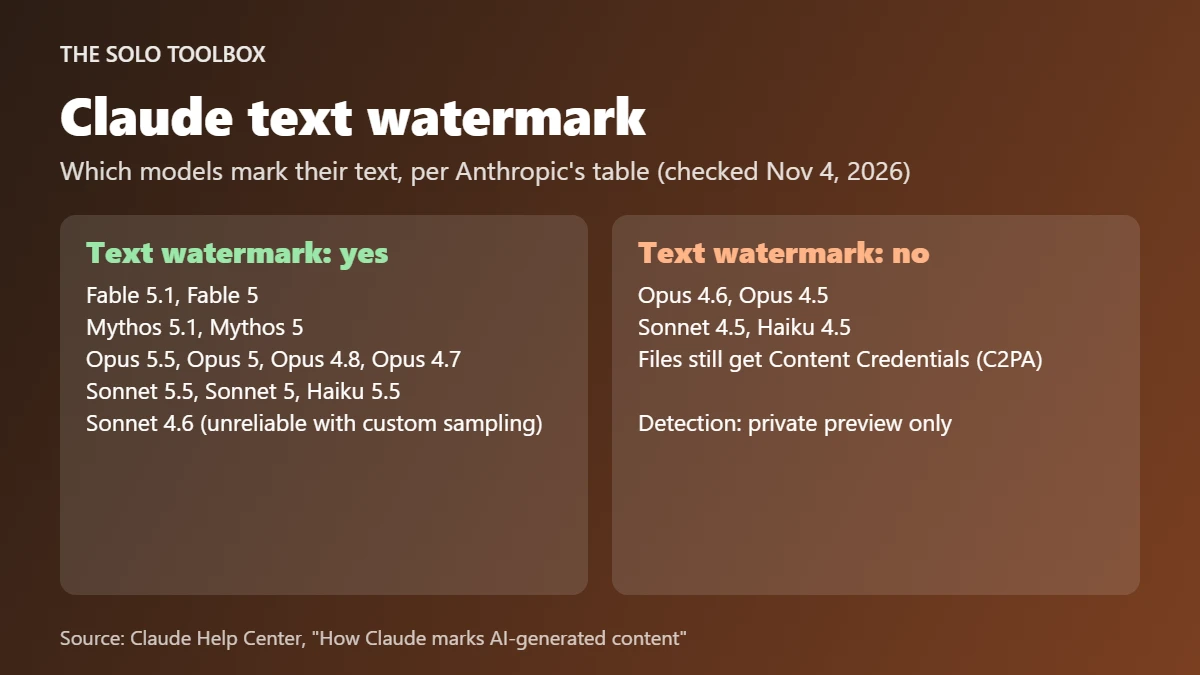
This is the first-party table from Anthropic’s help article, checked November 4, 2026.
| Model | Text watermark | Note |
|---|---|---|
| Fable 5.1, Fable 5 | Yes | |
| Mythos 5.1, Mythos 5 | Yes | Mythos 5 is one of the older models added in this rollout |
| Opus 5.5, Opus 5, Opus 4.8, Opus 4.7 | Yes | |
| Sonnet 5.5, Sonnet 5 | Yes | |
| Sonnet 4.6 | Yes, with a caveat | May not carry the mark when temperature, top_p or top_k is changed from the default |
| Haiku 5.5 | Yes | |
| Opus 4.6, Opus 4.5, Sonnet 4.5, Haiku 4.5 | No | Files get Content Credentials only |
Older models not in the table, such as Claude 3 models, aren’t mentioned by Anthropic. Don’t assume either way for those.
Where the watermark applies
- Anthropic’s own products: the Claude apps, Claude Platform (the API), Claude Code, Claude Cowork and Claude Tag.
- Cloud partners: Claude models served through AWS, Google Cloud and Microsoft Foundry. Anthropic says the Amazon Bedrock rollout will complete by November 10.
- Copied text: the mark is part of the words themselves, so it travels with text you copy into a document, email or CMS.
Anthropic describes the mark as woven “directly into the text itself” and says it does not change meaning or readability. It does not publish the method. No source we found reports hidden Unicode characters, so deleting invisible characters from a passage is not a way to find or remove it.
Can you turn the watermark off?
Anthropic’s help article does not describe any opt-out, for consumer plans or for business and API accounts. Press coverage, including the Independent, reports there is no opt-out. The only exception in Anthropic’s own text is the Sonnet 4.6 caveat: changing sampling settings can make the mark unreliable on that model. That is a side effect, not a setting meant to disable it.
If your contract or workflow depends on how Claude output is handled, ask your Anthropic account contact in writing rather than relying on secondhand reports.
Who can check text for the watermark
Detection is not public. Anthropic says watermark detection is in private preview for regulators, law enforcement, media, fact-checkers, independent researchers, educational organizations and EU civil society groups. Enterprises can also apply to check marks on their own Claude output. Access is by an application form linked from the help article, and Anthropic says it plans to widen access over time.
The free Claude Content Checker is a different tool. It reads Content Credentials on images and files, not the text watermark. Third-party “AI detectors” can’t read Anthropic’s mark either.
What can remove or weaken the mark
Anthropic lists the cases where a passage may test negative even though Claude wrote it:
- the text was heavily edited or paraphrased
- it was translated into another language
- it was mixed into other writing
- the passage is very short
- on Sonnet 4.6, non-default
temperature,top_portop_kwas used
The reverse also holds. Anthropic warns that a detected mark “is not fully conclusive,” because Claude may only have proofread or translated text a person wrote.
What it means for you
- Freelancers and agencies: if a client contract asks you to disclose AI use, a watermark makes undisclosed use easier to discover. Check your contracts and disclose where required.
- Students: schools can apply for detection access. A positive result is evidence, not proof, and a negative one proves nothing.
- Developers: output from the API carries the mark on supported models. If you sell generated text, tell customers. On Sonnet 4.6, changed sampling settings can make marking inconsistent, which matters if you need predictable behavior.
- Everyone: the watermark is a label, not a privacy change. It doesn’t send your chats anywhere new. If training use is your concern, that is a separate setting.
For that separate setting, see how to keep your chats out of AI training in ChatGPT, Claude, Gemini and Copilot. For the image side of AI labelling, our guide to checking an iPhone photo for a SynthID watermark covers Google’s approach.
Frequently asked questions
Does the watermark make Claude’s answers worse?
Anthropic says it doesn’t change meaning, quality or readability. We haven’t seen independent testing that measures this, so treat it as Anthropic’s claim.
Is my existing Claude text watermarked?
The mark is added when text is generated. Text produced before a model was switched on wouldn’t carry it. Anthropic doesn’t publish exact per-model switch-on times, so you can’t date a specific passage yourself.
Does this apply to Claude Code output?
Yes. Claude Code is on Anthropic’s list of marked surfaces. The help article covers text generally and doesn’t separate code from prose. If you also want tighter control over what Claude Code does, see how to switch Claude auto mode back to manual.
Can I check my own text?
Only through the private preview. Enterprises can apply to check their own output; individual users currently have no detector.
What to do next
If you use Claude for client or school work, read the disclosure rules that apply to you this week, and treat Claude text as labelled from now on. If you share a Claude account across devices, also review where you’re signed in.
Sources
- Claude Help Center: How Claude marks AI-generated content (checked November 4, 2026)
- GIGAZINE: Anthropic will add text watermarks to older versions of Claude starting November 3
- DEV Community: Anthropic switches on invisible watermarks in four older Claude models
- The Independent: Claude text watermark coverage
- Claude Content Checker (files and images)