Does the Riemann Hypothesis Proof Break Encryption? No

The Solo Toolbox · Software Help for One-Person Businesses
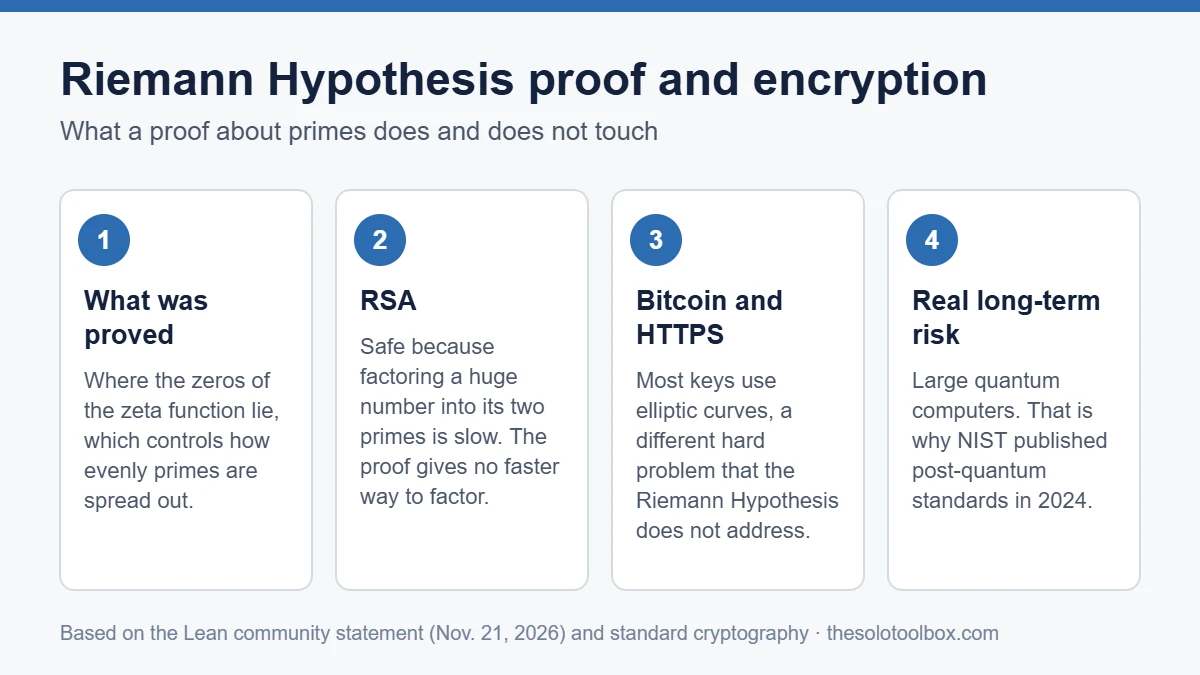
No. The Riemann Hypothesis proof verified this week does not break RSA, Bitcoin, HTTPS or any other encryption you use. RSA is safe because nobody knows a fast way to split a huge number into its two prime factors, and a proof about how primes are spread out doesn’t supply one. Bitcoin and most modern web connections rely on elliptic curves, a different math problem the Riemann Hypothesis doesn’t address.
Below: what was proved and by whom, why encryption doesn’t depend on it, what the proof does change, and the one encryption risk that is real.
Before you start
- Who this is for: anyone who saw the headlines and wondered whether their bank, password manager or crypto wallet is affected.
- Short answer: you don’t need to change anything. Treat any message urging you to move money because of this proof as a scam signal.
- How we checked this: on November 23, 2026 we read the Lean and Mathlib communities’ joint statement of November 21 and Scientific American’s November 20–21 coverage, and compared the claims with how RSA and elliptic-curve cryptography are built. No mathematician has yet published an analysis of the 17-million-line proof’s new methods, so its long-term research impact is unknown.
What was announced
- November 20, 2026: Levent Alpöge, a mathematician who works at Anthropic, posted that he had found a proof of the Riemann Hypothesis “working with Claude,” Anthropic’s AI model. He released it as a library written in Lean, a language that lets a computer check every logical step. Scientific American reports that he says the proof covers the Generalized Riemann Hypothesis, a broader version.
- November 21, 2026: the Lean and Mathlib communities, endorsed by the Lean FRO and the Mathlib Initiative, published a joint statement saying they “have full confidence” the proof is correct. Dozens of people compiled the code, two tools confirmed it proves Mathlib’s exact statement of the hypothesis, and several independent proof checkers accepted it.
- Still open: Scientific American also reported a second, competing claim of a proof on November 20. We haven’t assessed it. And as mathematicians have said, understanding why the proof works will take far longer than checking that it does.
The Riemann Hypothesis, posed by Bernhard Riemann in 1859, is a statement about where the zeros of a function called the zeta function lie. Those zeros control how evenly the prime numbers are spread along the number line. It was one of the Clay Mathematics Institute’s $1 million Millennium Prize Problems.
Why the proof doesn’t break RSA
RSA, published in 1977, still protects plenty of logins, software signatures and older web connections. Its security comes from one specific difficulty: if you multiply two very large primes together, nobody knows a fast way to recover them from the product. A 2048-bit RSA key is a product of two roughly 300-digit primes.
The Riemann Hypothesis says how primes are distributed on average. It doesn’t say how to find the particular two primes hidden inside one particular number. Knowing that primes are spread out in a very regular way is a different thing from being able to factor a 600-digit number, in the same way that knowing the average height of a population doesn’t tell you anyone’s name.
There’s also a practical reason the news changes little: cryptographers and mathematicians have long assumed the Riemann Hypothesis was true. Many results were published “assuming GRH.” Security was never resting on the hypothesis being false, so proving it true removes no protection.
Bitcoin, HTTPS and passkeys use different math
| What you use | What protects it | Affected by the proof? |
|---|---|---|
| Bitcoin and most crypto wallets | Elliptic-curve signatures (ECDSA and Schnorr on the secp256k1 curve) | No |
| HTTPS in current browsers | Elliptic-curve key exchange, increasingly combined with the post-quantum ML-KEM | No |
| Passkeys | Public-key signatures, usually elliptic-curve | No |
| Older RSA keys and certificates | Difficulty of factoring large numbers | No known effect |
| Passwords and password managers | Hashing and symmetric encryption such as AES | No |
Elliptic-curve cryptography depends on the discrete logarithm problem on an elliptic curve. The Riemann Hypothesis isn’t about that problem at all, so there’s no route from the proof to a Bitcoin private key.
What the proof does change in computing
Some algorithms had guarantees that only held “if the Generalized Riemann Hypothesis is true.” The best-known is Gary Miller’s 1976 primality test, which runs in polynomial time under that assumption. Those guarantees now hold without the condition.
In practice, little shifts. A test that proves a number is prime in polynomial time without any assumption (the AKS test) has existed since 2002, and the software that generates encryption keys uses fast probabilistic tests such as Miller–Rabin regardless. Key generation won’t get noticeably faster or safer.
The honest caveat: a proof this large may contain new techniques, and new techniques sometimes lead to new algorithms years later. Nobody has shown such a link here, and nobody can rule out future research outcomes. That’s different from the proof itself weakening encryption today.
The encryption risk that is real: quantum computers
If you want to worry about the math under your encryption, the threat is a large quantum computer. Shor’s algorithm, published in 1994, would let such a machine break both RSA and elliptic-curve cryptography. That’s why NIST published its first post-quantum encryption standards (FIPS 203, 204 and 205) in August 2024, and why browsers have started mixing post-quantum key exchange into HTTPS connections. None of that is related to the Riemann Hypothesis.
Watch for scams using the news
Big, confusing technical news is useful to scammers. If you get a message, video or “support agent” telling you this proof puts your wallet or bank account at risk and you need to move funds to a “secure” address or platform, it’s fraud. No legitimate exchange or bank will ask you to do that because of a math result. Our guide on how to check a trading platform before you deposit walks through the checks, and the Binance hack guide lists the scam scripts that tend to follow crypto headlines.
The proof also landed a day after Anthropic’s stock market debut, according to Scientific American. If the news has you looking at the shares, our explainer on how to buy Anthropic stock and spot fake offers covers the legitimate routes. That isn’t a recommendation to buy; we’re not financial advisers.
FAQ
Does the Riemann Hypothesis proof break Bitcoin?
No. Bitcoin signatures use elliptic-curve cryptography on the secp256k1 curve. Their security depends on the elliptic-curve discrete logarithm problem, which the Riemann Hypothesis does not address.
Is RSA encryption still safe after the Riemann Hypothesis proof?
Yes. RSA depends on the difficulty of factoring large numbers. The proof describes how primes are distributed on average and gives no faster way to factor a specific number. Mathematicians had long assumed the hypothesis was true.
Has the AI-assisted Riemann Hypothesis proof been verified?
On November 21, 2026 the Lean and Mathlib communities said they have full confidence it is correct, after independent compilation and checks by several proof checkers. Mathematicians are still studying how the proof works.
Do I need to change my passwords or keys?
No. Nothing about passwords, passkeys, HTTPS or crypto wallets changes because of this proof. Keep using strong, unique passwords or passkeys and keep your software updated.
What to do next
Nothing about your accounts needs to change. If you want a useful security step this week, switch an important account to passkeys, which our passkey setup guide for Google and Microsoft covers, and ignore anyone using the Riemann Hypothesis to rush you into moving money.
Sources
- Lean community blog: Lean verification of the Riemann Hypothesis (joint statement, November 21, 2026)
- Scientific American: Anthropic mathematician proves Riemann hypothesis (November 20, updated November 21, 2026)
- Scientific American: Dueling claims of Riemann hypothesis proofs emerge (November 20, 2026)
- NIST: FIPS 203, Module-Lattice-Based Key-Encapsulation Mechanism Standard (August 2024)
Last checked: November 23, 2026. If something here is out of date, let us know.