Shein $100M FTC Settlement: Will You Get a Refund?
The Solo Toolbox · Software Help for One-Person Businesses
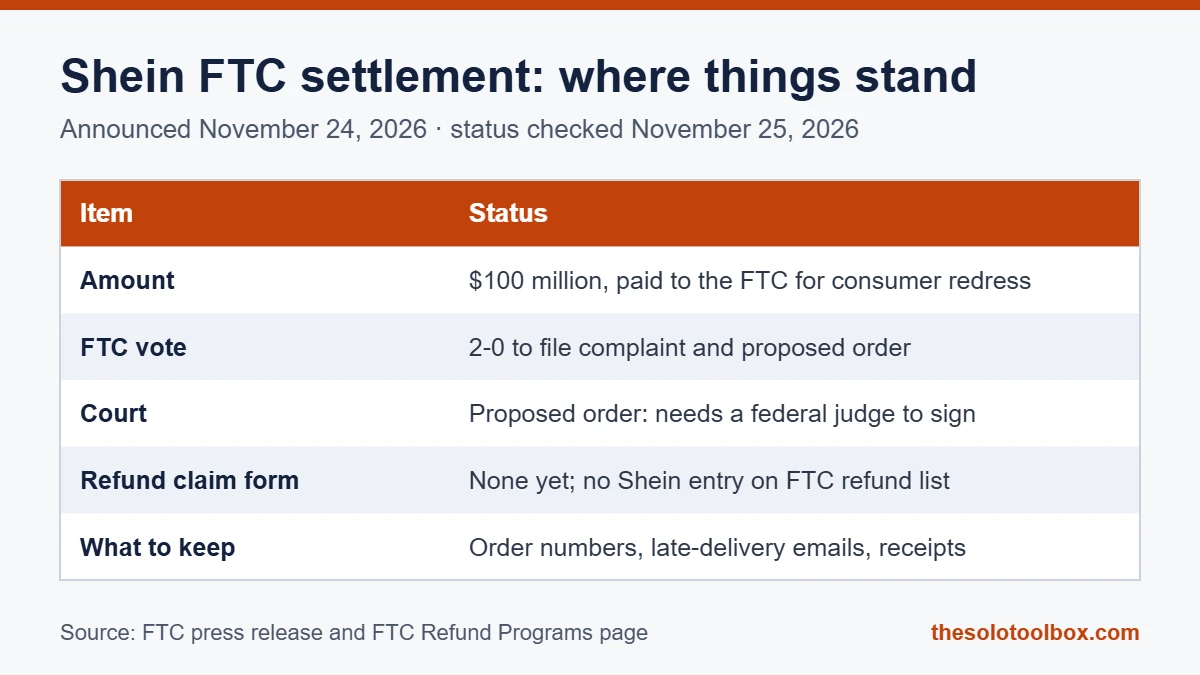
Not yet. Shein agreed on November 24, 2026, to pay $100 million to the Federal Trade Commission, and the FTC says that money will go to consumer redress, but there is no claim form and no refund program listed for Shein yet. The settlement is still a proposed court order that a federal judge has to sign before the FTC can decide how to pay people.
Below: what the FTC says Shein did, where the case stands, what to save now so you are ready if refunds open, how to deal with an order that is late today, and the refund scams to expect.
Before you start
- Who this is for: anyone in the U.S. who ordered from Shein and had a package arrive very late, never arrive, or had a review that seemed to disappear.
- Current status: settlement announced, court approval pending, no refund process yet.
- How we checked this: on November 25, 2026 we read the FTC’s November 24 press release and its Refund Programs page, which did not list a Shein refund. We have not read every page of the complaint, and Shein had not published a response in the coverage we checked.
What the FTC says Shein did
The FTC’s complaint, filed with a proposed settlement in the U.S. District Court for the Central District of California, makes five main claims:
- Late or missing orders: Shein advertised fast, reliable shipping, while tens of thousands of customers reported orders arriving days, weeks or months late, and some never arrived. The FTC says Shein did not send the delay notices the law requires.
- Almost no phone support: Shein ships close to one million packages a day to the U.S. but, as of September 2025, had five agents handling phone inquiries and did not list a phone number for them on its site.
- Hidden negative reviews: the FTC says Shein published positive reviews while suppressing or deleting reviews from people who criticized or returned products.
- Supplier audit claims: Shein marketed its evoluSHEIN products as coming from suppliers with above-average results in audits for child and forced labor, and the FTC says Shein had no audit backing that up.
- Cotton origin: cotton described as U.S.-grown came from China, according to the FTC, and cotton in some products could not be traced to any country.
The agency brought the case under Section 5 of the FTC Act, the Mail, Internet, or Telephone Order Merchandise Rule (usually called the Mail Order Rule) and the Rule on the Use of Consumer Reviews and Testimonials. The Commission voted 2-0 to file it.
What the settlement requires
Under the proposed order, Shein pays $100 million to the FTC and is banned from:
- misrepresenting shipping and delivery times
- suppressing negative product reviews
- failing to provide adequate customer service
- making deceptive claims about supplier or factory audits, or about where a product’s materials come from
The case is FTC v. SHEIN, No. 2:26-cv-13701. A stipulated order like this one has the force of law only once the judge approves and signs it. The FTC’s release, dated November 24, calls it a proposed order, so assume it is not final until the case page says otherwise.
Will Shein customers get refunds?
The FTC says the $100 million “will be used to provide redress to consumers,” which is the closest thing to a yes. What it has not said yet:
- who qualifies, for example only people with late or undelivered orders
- whether you will need to file a claim or will be paid automatically
- how much each person could get
- when payments would start
In past cases the FTC has used both methods: sometimes it pays people identified from the company’s own records, by check or PayPal, and sometimes it opens a claims website. It announces the method on its Refund Programs page, which on November 25, 2026 listed no Shein program. Payouts typically arrive months after a settlement, not weeks.
What to save now
If refunds use a claim form, the FTC may ask you to confirm orders or dates. Collecting the details now takes ten minutes:
- Open your order history in the Shein app or on the website and screenshot orders that arrived late, partially or not at all, with order numbers and dates visible.
- Search your email for “Shein” and keep the order confirmations, shipping notices and any refund or “order delayed” messages. Note orders where you received no delay notice at all.
- Keep card or PayPal statements showing the charges for those orders.
- Write down any review you posted that later vanished, with the product name and approximate date.
- Use the same email address and mailing address you used with Shein when you check for a refund later, since the FTC may match against company records.
If a Shein order is late right now
The settlement does not change your existing rights. The Mail Order Rule already requires online sellers to ship within the time they advertise, or within 30 days if they state no time. If they can’t, they must tell you and offer the choice to cancel for a full refund. For an order that is late today:
- Check the shipping estimate shown on the order and compare it with the date it was promised.
- Ask Shein for a refund on the undelivered items from the order page or through its customer service chat, and keep a copy of the conversation.
- If Shein doesn’t resolve it, dispute the charge with your card issuer. U.S. credit card users generally have 60 days from the statement that first showed the charge to dispute an item that never arrived, under the Fair Credit Billing Act. PayPal has its own purchase protection claim window.
- Report the problem at ReportFraud.ftc.gov. When we checked on November 25, 2026, that site showed a government shutdown notice and was not taking reports. If it is still down, file with your state attorney general’s consumer protection office instead.
Watch for fake Shein refund messages
A public $100 million settlement is easy bait during Black Friday week. Expect texts and emails claiming you are owed a Shein refund and asking you to “verify” a card or pay a processing fee. The FTC’s refund page says it will never threaten you, ask you to transfer money to get a refund, or promise you a prize. Real FTC refund information appears on ftc.gov, and payment partners are named there. If a message links anywhere else, don’t click it. Our guide to Black Friday scam emails and texts covers the other lures circulating this week.
| Real FTC refund | Scam refund message |
|---|---|
| Announced on ftc.gov/refunds | Arrives by text or social media DM first |
| Never asks you to pay anything | Asks for a fee, gift card or crypto |
| Payment by check or PayPal from named partners | Asks for your card number or bank login |
| No threats or deadlines measured in hours | Says you will “lose” the refund today |
Frequently asked questions
How much will each Shein customer get?
The FTC hasn’t said. The amount per person depends on how many people qualify and how the agency divides the $100 million, which it decides after the order is final.
Do I need to sign up somewhere now?
No. There is nothing to sign up for as of November 25, 2026. Any site asking you to register for a Shein refund now is not from the FTC.
Does this apply outside the United States?
No. This is a U.S. federal case, and redress is for U.S. consumers. Shoppers in other countries would need to rely on their own consumer protection agencies.
Can I still shop on Shein?
Yes. The settlement doesn’t stop Shein from selling in the U.S. It restricts how Shein describes delivery times, handles reviews and supports customers.
What to do next
Save your order records this week, then check the FTC’s Shein case page and Refund Programs page once a month. When you shop the Black Friday sales, check that the store you land on is the real one; our guide to fake shopping ads in search results shows the warning signs.
Related guides
Sources
- FTC: SHEIN to Pay $100 Million Over Allegations of Deceptive and Unfair Practices (November 24, 2026)
- FTC v. SHEIN complaint (PDF)
- Proposed stipulated order (PDF)
- FTC: Refund Programs
- FashionUnited: FTC confirms Shein will pay 100 million dollars (November 25, 2026)
Last checked: November 25, 2026. If something here is out of date, let us know.