MacBook Pro M6 vs touchscreen MacBook Pro: is OLED and touch worth $900 more?
For most people buying a MacBook Pro for work, the $1,999 14-inch MacBook Pro with M6 is the better buy. The MacBook Pro with PROLED XDR Display, Apple’s first touchscreen Mac, starts at $2,899 and earns its higher price only if you need its brighter OLED screen, its faster M5 Pro or M5 Max chips, or a lighter machine. Both go on sale on Friday, November 6, 2026.
The two laptops were announced a day apart, on October 27 and 28, and they’re easy to confuse. They’re aimed at different buyers. This guide compares what each one includes, using Apple’s announced specifications and prices, and explains who should pay the extra $900. We haven’t tested either laptop; this comparison is based on Apple’s specifications and launch coverage.
Before you start
- Release date: both models are available from Friday, November 6, 2026
- Starting prices (US): $1,999 for M6; $2,899 for the 14-inch PROLED XDR model
- Education pricing: $1,899 for M6; $2,749 for the 14-inch PROLED XDR model
- Still on sale: the regular MacBook Pro with M5 Pro or M5 Max, from $2,499
The MacBook Pro lineup now has three tiers
Apple didn’t replace the MacBook Pro this autumn. It added to it, so there are now three 14-inch options:
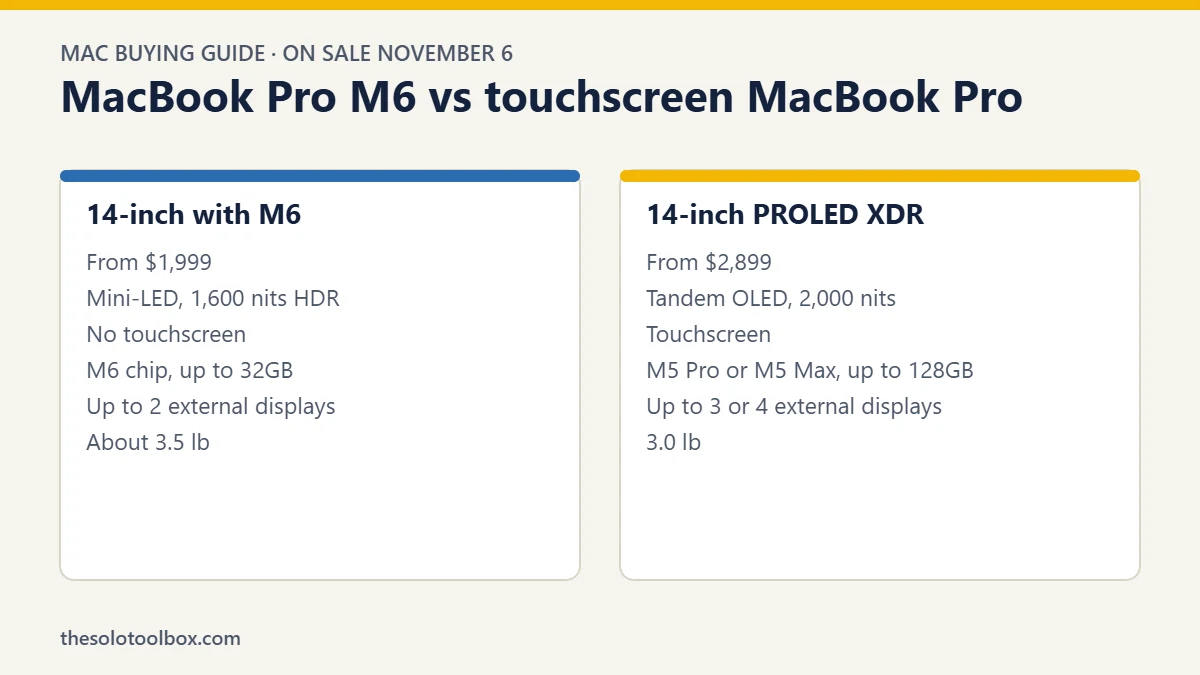
| MacBook Pro with M6 | MacBook Pro with M5 Pro | MacBook Pro with PROLED XDR Display | |
|---|---|---|---|
| Starting price | $1,999 | $2,499 | $2,899 |
| Chip | M6 (12-core CPU, 12-core GPU) | M5 Pro or M5 Max | M5 Pro or M5 Max |
| Display | Mini-LED Liquid Retina XDR | Mini-LED Liquid Retina XDR | Tandem OLED (PROLED XDR) |
| Touchscreen | No | No | Yes |
| Peak brightness | 1,600 nits HDR | 1,600 nits HDR | 2,000 nits HDR and SDR |
| Starting memory and storage | 16GB, 1TB | 24GB, 1TB | 24GB, 1TB |
| Weight (14-inch) | About 3.5 pounds | About 3.5 pounds | 3.0 pounds |
| Battery life (Apple’s claim) | Up to 24 hours | Up to 24 hours | Up to 24 hours |
The PROLED XDR model also comes in a 16.3-inch size from $3,399. The M6 model is 14-inch only.
One detail matters for comparisons: the touchscreen model costs $400 more than a regular MacBook Pro with the same chip, memory and storage, according to Apple’s pricing. The full $900 gap to the M6 model pays for two things at once: a better chip and a better screen.
What the extra money buys
A brighter, touch-sensitive OLED screen
The PROLED XDR display uses tandem OLED, the stacked OLED design Apple first used in the iPad Pro. Apple quotes up to 2,000 nits of peak brightness for both HDR and everyday (SDR) content, up to 1,000 nits sustained, a 10,000,000:1 contrast ratio and a 120Hz ProMotion refresh rate. Touch is built into the panel itself, and Apple redesigned the hinge so the lid stays steady when you press the screen.
The M6 model keeps the mini-LED screen that MacBook Pros have used since 2021. It’s still very good, with up to 1,600 nits for HDR, but it can’t match OLED’s black levels, and it doesn’t respond to touch.
The practical question is how much you’ll use touch. Early hands-on reports describe it as smooth for scrolling, switching apps and sketching, but the keyboard and trackpad stay the main way to use a Mac. If you’ve never wanted to reach out and tap your laptop screen, this isn’t the reason to spend $900.
Faster chips for heavy work
The PROLED XDR model only comes with M5 Pro or M5 Max, with up to 128GB of memory. The M6 is newer, built on a smaller process, and Apple says its graphics are up to 30% faster than the M5’s, but it’s the standard chip in the family, not a Pro or Max.
That shows up in two places:
- Memory ceiling. The M6 model tops out at 32GB, according to Apple’s configuration options. If you edit long 4K or 8K video, work with large photo libraries or run local AI models, the Pro and Max chips’ higher memory limits matter more than the screen.
- External displays. The M6 model drives up to two external displays. The PROLED XDR model supports up to three with M5 Pro and four with M5 Max.
A lighter body
At 3.0 pounds for the 14-inch and 4.0 pounds for the 16-inch, the PROLED XDR models are noticeably lighter than the regular MacBook Pros at about 3.5 and 4.7 pounds, according to Apple’s specifications as compiled by 9to5Mac. If you carry your laptop all day, that’s a real difference.
What you don’t get for the extra money
- More battery life. Apple quotes up to 24 hours for both.
- Newer ports. The PROLED XDR model has Thunderbolt 5 ports and the M6 model has Thunderbolt 4, but both have HDMI, an SD card slot, MagSafe and a headphone jack. For most monitors, drives and docks, Thunderbolt 4 is plenty.
- A cheaper anti-glare option. The nano-texture screen finish is a $150 extra on either model.
Which MacBook Pro should you buy?
Buy the MacBook Pro with M6 if you work in documents, spreadsheets, browsers, video calls, photo editing and the occasional short video edit. It’s the cheapest way into a MacBook Pro, with the newest chip, a 1TB drive as standard and the same battery life as the more expensive model. Spend part of the savings on more memory: if you keep many apps and browser tabs open, our guide to choosing between 16GB and 24GB on an M6 Mac will help you decide.
Buy the MacBook Pro with PROLED XDR Display if you do colour-critical photo or video work, work outdoors or in bright rooms often, need more than 32GB of memory or three or more external displays, or carry your laptop all day and value the lighter body. If touch is the only feature you want, consider whether an iPad alongside your current Mac would do the job for less.
Consider the regular M5 Pro MacBook Pro if you need the Pro chip’s performance and memory but don’t care about OLED or touch. It’s $400 cheaper than the same configuration with the PROLED XDR display.
Consider waiting if you aren’t in a hurry. Black Friday is November 27 this year, and Apple’s newest laptops rarely see big discounts in their first weeks, but retailers have already been cutting prices on older models. We track verified prices in our daily tech deals roundup.
Prices have gone up this year
If $1,999 seems high for an entry-level MacBook Pro, you’re not imagining it. Apple raised Mac prices in June 2026, citing the industry-wide shortage of memory chips, and the base MacBook Pro now starts with a 1TB drive rather than 512GB. For years, the cheapest 14-inch MacBook Pro was $1,599. If you need macOS but not “Pro” features, the 13-inch MacBook Air with M5 starts at $1,299 and handles everyday office work comfortably.
FAQ
When can I buy the touchscreen MacBook Pro?
Pre-orders opened on October 28, 2026, and the MacBook Pro with PROLED XDR Display is available from Friday, November 6, 2026. The M6 MacBook Pro launches the same day.
Is the M6 faster than the M5 Pro?
Not across the board. The M6 is a newer generation, with faster graphics and AI processing than the M5, but the M5 Pro has more processor and graphics cores and supports more memory, so it’s still the stronger chip for sustained heavy work.
Is there a 16-inch MacBook Pro with M6?
No. The M6 is available only in the 14-inch MacBook Pro. The 16-inch models use M5 Pro or M5 Max.
How we checked this: prices, availability and specifications come from Apple’s October 27 and 28, 2026 announcements and its online store, cross-checked against coverage from 9to5Mac, Tom’s Guide and Stuff on November 2, 2026. We have not tested either laptop. Prices are for the US and can change; check Apple’s store before ordering.
Sources
- Apple Newsroom: Apple unveils MacBook Pro with PROLED XDR Display (October 28, 2026)
- Apple: MacBook Pro technical specifications
- 9to5Mac: MacBook Pro with PROLED XDR vs MacBook Pro compared
- Stuff: MacBook Pro M6 vs MacBook Pro with Touch Display
- TidBITS: M6 comes to the 14-inch MacBook Pro and iMac