90 days without power: what would happen to your phone, the internet and your money
The Solo Toolbox · Software Help for One-Person Businesses
When Hurricane Maria hit Puerto Rico in September 2017, it caused the longest continuous blackout in U.S. history. Two days after landfall, the FCC reported that 95.6% of the island’s cell sites were out of service. Power wasn’t restored to the last neighborhoods until August 2018, almost 11 months later. For millions of people, months without electricity stopped being a thought experiment.
So what would 90 days without power do to the technology most of us rely on: phones, Wi-Fi, cloud accounts, card payments, GPS and electric cars? Mostly, it depends on how big the outage is. Below, we go through each piece using real outages, government standards and published data, and we say clearly where the evidence ends and the scenario begins.
The short version
- Scale decides almost everything: a local outage leaves the wider network intact; a regional or national one leaves backup power and fuel deliveries as the only lifeline.
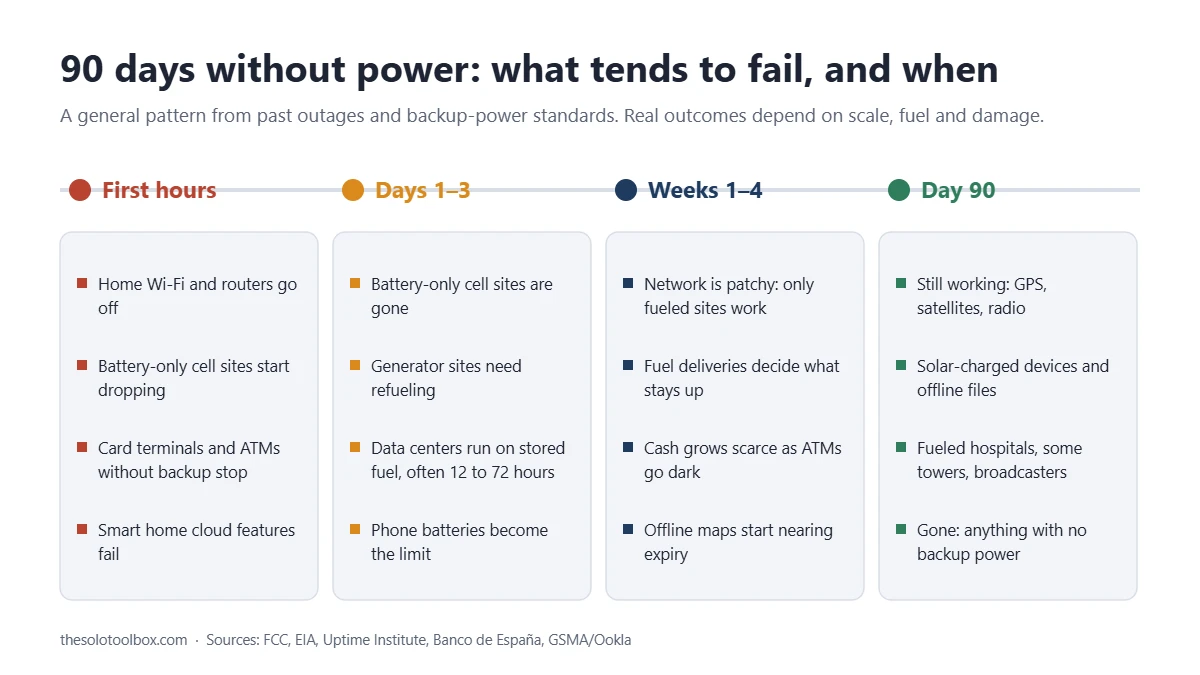
- Cell service fades in hours to days: battery-only sites drop first; generator sites last as long as their fuel.
- Your phone still works offline: GPS, downloaded maps and files, and satellite SOS on supported models.
- Cloud services stay up elsewhere: the hard part is reaching them, and signing in if you rely on text-message codes.
- Cash and offline copies matter: card payments and cash withdrawals in Spain fell by about 55% during its 2025 blackout.
Local outage vs. grid failure: why scale changes everything
A blackout that covers one town is a different event from one that covers a whole country. In a local outage, most of the infrastructure your devices depend on sits outside the dark zone: data centers in other states, fuel depots with power, and repair crews driving in from elsewhere. Your phone may lose its nearest tower, but the network around you keeps working.
A wide-area failure removes those outside supports. Every backup system then depends on the same few things: how much fuel is stored on site, whether trucks can deliver more, and whether the people who run the equipment can get to work. Four questions decide almost every outcome in this article:
- How large is the dark area? One county, one region, or most of a country.
- What backup power is installed? Batteries last hours. Generators last as long as their fuel.
- Can fuel get through? Pumps, terminals and payment systems at fuel stations also need electricity.
- Is the equipment physically intact? A storm that floods a cell site is harder to fix than a grid that tripped offline.
For a sense of what’s normal: the U.S. Energy Information Administration says the average American electricity customer had about 11 hours of interruptions in 2024, nearly double the previous decade’s average, mostly because of hurricanes. A 90-day nationwide blackout would be hundreds of times longer than anything in that data. No modern country has had one. Puerto Rico after Maria is the closest real-world case, so we lean on it, along with the April 2025 blackout in Spain and Portugal, which showed how fast networks degrade over a single afternoon.
What happens to the internet when the power goes out?
The internet doesn’t have an off switch. It’s a mesh of thousands of independently powered networks, and traffic routes around whatever is dark. If the outage covers your region, the internet elsewhere carries on. The problem is getting from your home to it.
That last stretch is the weakest part. Your router and modem stop the moment the wall socket goes dead. Beyond your house, cable and fiber networks rely on neighborhood cabinets and nodes, many of which run on batteries for a limited time, and on larger switching buildings that usually have generators. When the Iberian Peninsula lost power for about ten hours on April 28, 2025, mobile and fixed networks went down across wide areas almost immediately, according to an analysis of Ookla data published by Broadband Breakfast. In the providers that coped best, backup power and route diversity made the difference.
Over 90 days, expect home internet in the affected region to be gone unless you power your own equipment and your provider keeps its local network running on generators. Websites and apps hosted outside the region would still be online. You just couldn’t reach them without a working connection.
How long can cell towers run without electricity?
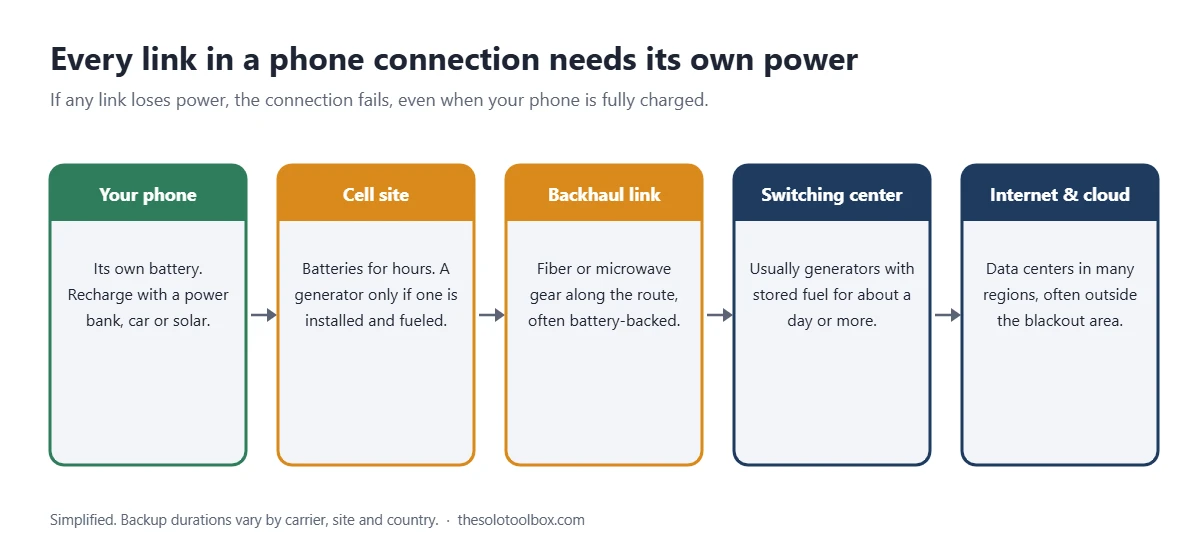
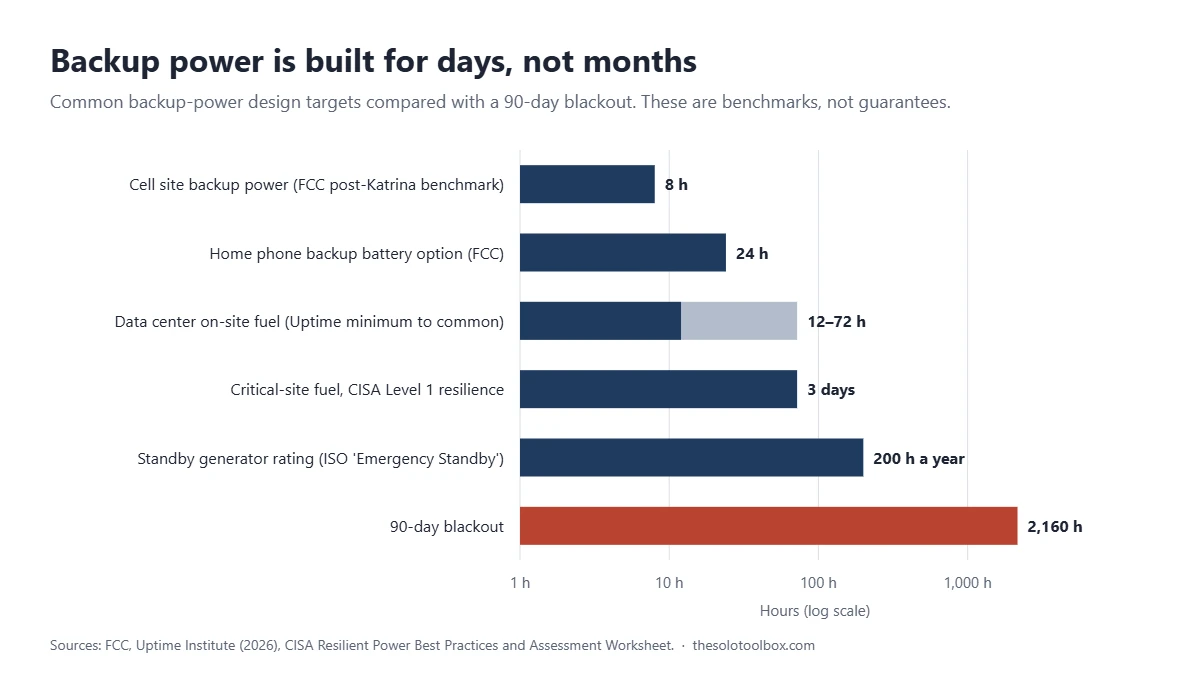
Cell sites use batteries for short outages and diesel or propane generators for longer ones, but not every site has a generator. After Hurricane Katrina, the FCC adopted a benchmark of at least eight hours of backup power for cell sites and 24 hours for telephone central offices. Carriers pushed back hard. They argued that a one-size rule didn’t fit every site and that some rooftop locations couldn’t safely hold the weight of the batteries needed. In practice, backup still varies from site to site and carrier to carrier.
Real outages show the pattern clearly:
- Spain, April 2025: At the peak of the blackout, more than half of mobile users across large parts of Spain had no signal at all, according to a GSMA analysis of Ookla data. Sites stayed up on batteries at first, then dropped off as those batteries ran down over the afternoon.
- Puerto Rico, 2017–2018: FCC status reports show the share of cell sites out of service falling slowly. It was still 39.6% in mid-November, nearly two months after the storm, and around 4% by March 2018. Maria also physically damaged towers and fiber, so these figures reflect storm damage as well as lack of power.
- Mobile generators help, within limits: In an FCC filing, American Tower said it keeps around 5,000 shared generators it can move to sites as needed. That’s a large fleet, but it’s a small share of the country’s cell sites, which already numbered around 210,000 towers and rooftop sites back in 2007.

For a 90-day outage, the realistic picture is a patchy network. Sites with generators and regular fuel deliveries would keep working, often under heavy load because everyone is trying to use them at once. Sites that run on batteries alone would be gone within the first day. A tower also needs its backhaul, the fiber or microwave link that connects it to the rest of the network, and that equipment needs power too.
Would smartphones still work?
The phone itself works fine without the grid. What it loses is the network and a way to recharge. Plenty of features don’t need a signal:
- GPS positioning: The GPS chip reads satellite signals directly. Without mobile data the first location fix can take longer, but it works.
- Offline maps: Google Maps lets you download areas in advance. Google says downloaded maps have to be updated before they expire, and the app tries to refresh them automatically over Wi-Fi in the last 15 days. During a long outage with no Wi-Fi, keep an eye on those expiry dates.
- Downloaded files: Documents, music, podcasts and videos saved on the device, plus the camera, notes, calculator and flashlight.
- Satellite SOS: On iPhone 14 and later, Emergency SOS via satellite lets you text emergency services when there’s no cellular or Wi-Fi coverage, in the countries where Apple offers it. Some recent Android phones have similar satellite features. Check your phone’s settings so you know whether yours does before you need it.
Battery life becomes the real limit. Low Power Mode on iPhone and Battery Saver on Android help, and so does turning off radios you can’t use. Over three months you’d need a steady way to recharge: a car charger (while you still have fuel), a solar panel, or a battery bank that you can top up from solar.
What happens to Wi-Fi and home routers?
Wi-Fi goes off the instant your router loses power. A small uninterruptible power supply (UPS) or portable power station can keep the modem, fiber terminal and router running, and these devices usually draw little power. Check the wattage on each power adapter and add them up to estimate runtime.
The catch is that a powered router only helps if your provider’s network is still up. Your local Wi-Fi can look perfectly normal on your phone while the connection beyond your house is dead.
Home phone service has changed in a similar way. Traditional copper landlines carried their own power, so they often worked in blackouts. Fiber and cable phone service doesn’t. In the U.S., the FCC requires providers of this kind of home voice service to offer customers the option to buy a backup battery that lasts at least 24 hours. That’s useful for a storm. It won’t cover a 90-day outage.
Would Google, Apple, Microsoft and Amazon services stay online?
Almost certainly, outside the affected area. The big cloud providers spread their infrastructure across many countries. Amazon Web Services, for example, says each Availability Zone has independent, redundant power and is designed to be fed by its own power substation, with zones in a region placed far enough apart to avoid shared failures like a utility outage. Google, Microsoft and Apple run similar multi-region setups.
Regional failures still happen, though. In October 2026, a power event in a Google Cloud region in London knocked out sign-ins, card payments and transfers for many Revolut customers. We covered it in our Revolut outage explainer. In a long blackout, services that depend on one data center region could fail or move elsewhere, and some would come back slower than others.
The more personal risk is getting locked out of your own accounts. If your sign-in relies on a code sent by text and the cell network is down, that code won’t arrive. Passkeys, an authenticator app and printed backup codes don’t depend on SMS. Our guides on setting up passkeys for Google and Microsoft and Microsoft Authenticator backups on Android walk through it.
What happens to data centers and cloud storage?
Data centers are built for power cuts. A bank of batteries carries the load for the seconds it takes diesel generators to start, and the generators take over from there. The Uptime Institute’s Tier Standards require certified facilities to store at least 12 hours of fuel on site, and many store enough for 48 or even 72 hours, according to an April 2026 Uptime Institute report.
After that, everything depends on fuel deliveries. A 90-day outage would mean continuous refueling for three months. Standby generators also aren’t always designed for that kind of duty. CISA’s resilient power worksheet lists the “Emergency Standby Power” generator rating as limited to 200 hours of operation a year, which is about eight days. CISA’s best-practice guidance also warns that fuel and generators become valuable targets during outages, and that history shows desperate people sometimes take them.
For your files, a power cut in one data center usually makes data temporarily unavailable rather than destroying it, especially with providers that copy data across several sites. What you lose in a regional blackout is access. That’s the argument for keeping an offline copy of the files you’d need most. Our guides on backing up a Google account with Takeout, backing up a Windows 11 PC for free and backing up an Android phone cover how to make one.
Would ATMs, banking apps and digital payments work?
ATMs, card terminals and banking apps all need electricity and a network connection at your end, even when the bank’s own systems are running fine. Spain’s 2025 blackout is the best recent evidence. The Banco de España reported that the number of card payments and cash withdrawals fell by about 55% compared with a normal Monday. Large retailers with backup power and terminals that could approve some payments offline did better. Many small shops without either had to close.
The payment systems themselves worked. The Bank of Spain said its supervised infrastructures processed transactions correctly thanks to their contingency systems. The failure was at the edges: shops, ATMs and phones. Cash got people through that afternoon, which is why Spain’s central bank, in line with European Commission advice, now recommends keeping some cash at home for emergencies.
Over 90 days, cash would matter more and get harder to find, because ATMs need power and cash deliveries need fuel. If you run a business, our guide to taking card payments without a website covers the readers small sellers use. It’s worth checking whether yours can store payments offline and for how long.
Would satellites and GPS keep working?
Yes. Satellites run on solar power and aren’t connected to any national grid. The GPS constellation is controlled from a master control station at Schriever Space Force Base in Colorado, with a fully operational alternate master control station at Vandenberg Space Force Base in California. That redundancy exists for exactly this sort of scenario.
The satellites can also carry on without the ground for a while. A 1995 National Academies study of GPS noted that Block IIR satellites were designed to keep their specified accuracy for up to 180 days without contact from ground control. Newer satellites have since joined the constellation, but the principle is the same: GPS doesn’t stop working because a city loses power.
What can fail is the equipment on the ground: the receiver in your car, a navigation app that needs data to load maps, or a satellite internet dish with no power source. Satellite internet services still need power at your end for the dish and router, and they rely on the operator’s ground infrastructure elsewhere.
How would electric vehicles be affected?
An EV parked with a full battery keeps most of its charge for weeks. The problem is recharging. Home chargers and public chargers both need grid power, so over 90 days an EV is only useful if you can charge it from solar panels or a generator.
EVs can also become backup power. With a bidirectional-capable vehicle and the right home equipment, vehicle-to-home (V2H) setups can run a house’s essential circuits. Tesla says V2H can back up an average household through a multiple-day outage. Both the car and the charger must support it, and the home needs a way to disconnect safely from the grid. Some vehicles also have outlets (vehicle-to-load) for running a fridge or charging devices without any home installation.
Gas and diesel cars aren’t automatically better off. Fuel pumps and payment systems at gas stations need electricity. FEMA lists inoperable pumps as a common problem in disasters, and after Hurricane Irma in 2017, many Florida stations stayed closed even when they had fuel because they had no power to pump it.
What happens to smart homes and connected devices?
Every plug-in smart device goes dark with the power. When backup power comes back, the ones that depend on a company’s cloud servers may still not work if your internet is down. Voice assistants, many cameras and some thermostats fall into this group.
Devices built for local control fare better. Matter, the smart home standard backed by Apple, Google, Amazon and Samsung, is designed so devices can be controlled over your home network without internet or cloud services, as long as your hub and router have power. Battery-powered smart locks generally have a physical key or keypad backup. Know where yours is, and replace the batteries before you need them.
For a long outage, the practical move is to know which devices need the cloud, keep manual overrides (light switches, door keys, thermostat controls) working, and decide which few devices are worth powering from a battery.
Could emergency generators keep technology running?
For a few days, yes. For 90 days, fuel and maintenance become the limit. A portable generator burns through its tank in hours of continuous use, so three months would mean storing or buying a large amount of fuel at a time when gas stations may not be pumping. Generators also need oil changes and maintenance when they run for long periods.
Safety matters more than runtime. Ready.gov, FEMA’s preparedness site, says generators should only run outdoors, at least 20 feet from windows, doors and attached garages, and that every level of your home should have a working carbon monoxide detector with battery backup. Carbon monoxide poisoning from generators is a well-documented cause of deaths after storms.
For long outages, many households pair batteries with solar panels instead. A portable power station charged by a solar panel won’t run an air conditioner, but it can keep phones, a laptop, a router, lights and a radio going for as long as the sun shines, with no fuel to store.
What technology would still work after 90 days?
By the third month of a wide-area blackout, the technology that still works falls into three groups.
- Things that don’t need the local grid: GPS and other satellite signals, battery-powered or hand-crank radios, and devices charged by solar.
- Things on fueled backup: Some cell sites, hospitals, emergency services, data centers and broadcast stations. In Puerto Rico, the FCC’s reports after Maria tracked radio and TV stations that stayed on air. Broadcast radio is one of the most reliable ways to get news in a long blackout.
- Things stored on your devices: Offline files, downloaded maps (until they expire), saved documents and photos.
Anything that needs grid power at your end with no backup would be gone: home internet, most smart home features, ATMs without generators, and EV charging without solar.
How to prepare your technology for a long blackout
You don’t need a bunker. A short list covers the most useful steps for anything from a two-day storm to a long regional outage:
- Keep offline copies of key documents: IDs, insurance policies, medical information and important contacts, on a USB drive and on paper.
- Fix your sign-in recovery now: Set up passkeys or an authenticator app, and print backup codes for your main accounts so a dead cell network can’t lock you out.
- Download offline maps for your area and check their expiry dates.
- Buy power you can recharge: One or two power banks, plus a solar panel or portable power station that you can recharge from solar.
- Put your modem and router on a small UPS to ride out short outages.
- Get a battery or hand-crank radio for news when phones and internet are down.
- Keep some cash in small bills.
- Learn your phone’s satellite SOS feature, if it has one, and try the demo.
- Know which smart devices have manual overrides, and keep physical keys where you can find them.
- If you use a generator, run it outdoors, at least 20 feet from the house, with CO detectors inside.
FAQ
Do landlines work during a power outage?
Traditional copper landlines usually do, because the phone company powers the line. Phone service delivered over fiber or cable needs power at your home, so it only works if you have a backup battery. Cordless phones need their own power too.
Could a nationwide grid failure really last 90 days?
It would take damage to hard-to-replace equipment, not just a grid that tripped offline. Large power transformers are one example. A 2024 report from the National Infrastructure Advisory Council, citing Wood Mackenzie data, said average lead times for new transformers had grown to about 120 weeks, and up to 210 weeks for the largest units. That’s why grid operators keep spares and share equipment. Ordinary outages, even large ones, are restored in hours or days. Spain and Portugal’s 2025 blackout lasted about ten hours for most people.
Is my cloud data lost if a data center loses power?
Usually not. Major providers copy data across multiple sites, and a power cut generally makes data unreachable rather than deleted. An offline backup protects you from the access problem.
Related guides
Sources
- U.S. Energy Information Administration: U.S. electricity customers averaged 11 hours of interruptions in 2024
- FCC: Communications Status Report for Areas Impacted by Hurricane Maria, September 22, 2017
- FCC: Communications Status Report, October 5, 2017
- TV Technology: 89 percent of cell sites still down in Puerto Rico (October 1, 2017 FCC data)
- FCC: Communications Status Report, October 16, 2017
- FCC: Communications Status Report, November 13, 2017
- FCC: Communications Status Report, March 7, 2018
- FCC: Communications Status Report, March 16, 2018
- Fortune: Power restored to last neighborhood in Puerto Rico affected by Hurricane Maria
- RCR Wireless: FCC post-Katrina backup power rules for cell sites and central offices
- TechCrunch: Cell carriers fight FCC over backup power
- Light Reading: 5G providers reject mandates for backup power at cell sites
- GSMA: How Spain’s mobile networks performed during the Iberian grid collapse
- Broadband Breakfast: Iberian blackout highlights gaps in telecom network resiliency
- FCC: 24-hour home backup power requirement
- AWS: Availability Zones (AWS Fault Isolation Boundaries)
- Uptime Institute: Energy crisis elevates the importance of fuel management (April 2026)
- CISA: Resilient Power Best Practices for Critical Facilities and Sites
- CISA: Resilient Power Assessment Worksheet
- Banco de España: The impact of the 28 April 2025 blackout on Spain’s payment systems
- Banco de España blog: How do we pay when the power goes out?
- GPS.gov: GPS control segment
- National Academies: The Global Positioning System, A Shared National Asset (1995)
- Apple Support: Connect to a satellite with your iPhone
- Google Maps Help: Download areas and navigate offline
- Tesla: Bidirectional charging 101, vehicle-to-home
- FEMA: Restoring Flow placemats for food and fuel
- NPR: With power out, many Florida gas stations remain closed
- Home Assistant: Matter integration and local control
- Ready.gov: Power outages
- Utility Dive: NIAC report on transformer lead times