Tidal AI Music Ban: What Changes Dec 9 for Listeners and Artists
The Solo Toolbox · Software Help for One-Person Businesses
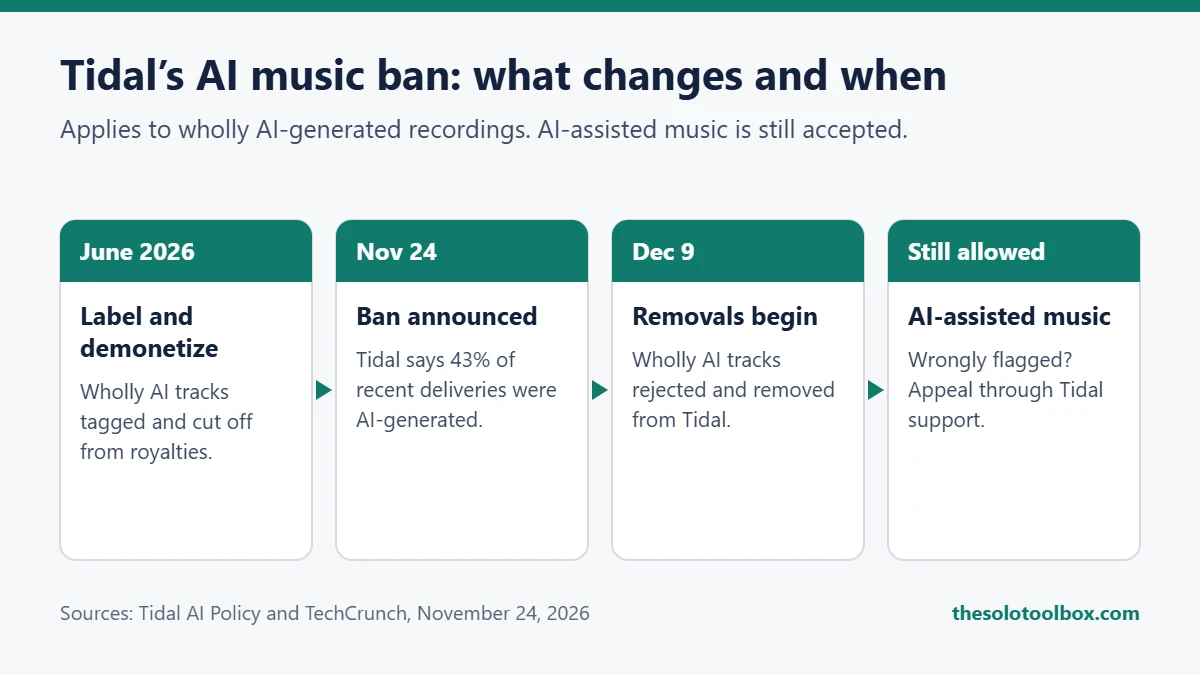
Tidal will reject and remove every wholly AI-generated track starting December 9, 2026. The streaming service announced the ban on November 24, saying more than 43% of tracks delivered to it in the previous 90 days were detected as AI-generated. Music made with AI assistance is still allowed; only recordings generated entirely by AI are affected.
Below: exactly what Tidal’s policy covers, the numbers it gave, what changes for listeners and for artists who use AI tools, how to appeal a wrong flag, and how Tidal’s rules compare with Spotify, Deezer, YouTube Music and Bandcamp.
Before you start
- Who this is for: Tidal subscribers, independent musicians who distribute to Tidal, and anyone using AI tools in their music workflow.
- Time needed: 5 minutes to read; nothing to do for most listeners.
- How we checked this: on November 25, 2026 we read Tidal’s AI Policy page on its support site (updated November 24 with the December 9 change) and TechCrunch’s November 24 report on the announcement. Tidal’s support page does not give the exact name of the in-app setting for hiding AI tracks, so we describe it as Tidal does.
What Tidal announced on November 24
Tidal’s AI Policy page now carries a notice: starting December 9, 2026, any wholly AI-generated track submitted to Tidal will be rejected and removed from the platform. According to TechCrunch’s report on the announcement, Tidal also said:
- More than 43% of tracks uploaded to the platform over the past 90 days were AI-generated.
- About 27 million tracks, or 6.3% of its catalog, are fully AI-generated, and 96% of those have no streams.
- The removals will delete more than 29 million songs by the end of 2026. TechCrunch reports both the 27 million and 29 million figures without explaining the gap; it may include tracks that arrive before December 9.
- Once the rules are in force, Tidal expects to reject roughly 80,000 to 85,000 tracks a day.
- Distributors may no longer deliver 100% AI-generated tracks, and Tidal will reject submissions whose metadata says they were made fully with AI.
This is a step up from June 2026, when Tidal started labeling wholly AI-generated tracks and stopped paying royalties on them. Robert Anderson, who leads Tidal Music, said on X that the demonetization did not stop the flood of uploads.
What counts as “wholly AI-generated” on Tidal
Tidal’s definition is narrow on purpose. It acts only on recordings that were generated entirely with generative AI. Tidal says detection tools aren’t reliable enough to judge partially AI-made tracks, and it wants to avoid false positives. Its policy also says it takes no action on AI-generated compositions, meaning the written song as opposed to the recorded audio.
| Example | Affected from Dec 9? |
|---|---|
| Track generated end to end by an AI music app | Yes: rejected and removed |
| Human-recorded vocals over an AI-generated backing track | Not under the current wording, which targets wholly AI recordings (our reading) |
| Song written with AI help, recorded by people | No: Tidal takes no action on AI compositions |
| Human recording with AI mixing or mastering tools | No |
| Release whose metadata says it is fully AI-generated | Yes: rejected at submission |
Tidal says it may expand action to “substantially” AI-generated recordings as detection improves, so the line could move later. Separately, it can already remove AI music tied to fraud, impersonation of real artists or unusual streaming activity.
What changes for Tidal listeners
Most subscribers won’t need to do anything. Since 96% of the fully AI tracks Tidal identified have no streams, few playlists should notice. If you saved AI-generated tracks, expect them to disappear from your library and playlists after December 9.
Until then, Tidal’s current policy lets you turn off AI-labeled recordings in the app’s Settings. With that off, labeled tracks won’t play and drop out of your personalized recommendations as they refresh, which Tidal says usually happens daily, though album recommendations can take a few days.
If you find a track you think is fully AI-generated but not labeled, Tidal asks you to report it through its support form. Choose I need help with a copyright or trademark violation or AI tagging, then I want to file an AI flag review, then This track wasn’t tagged as AI but should be.
What changes for artists and distributors
If you use AI tools but perform, record or substantially create the audio yourself, Tidal says you can keep releasing there. The practical risk is a wrong flag. These steps make an appeal easier:
- Check your distributor’s AI disclosure. If your distributor asks whether a release used AI, answer accurately and precisely. Tidal will reject anything whose metadata says it was made fully with AI, so don’t choose that option for a track you recorded.
- Keep your project files. Session files, stems, raw vocal takes and dated drafts are the easiest way to show a recording wasn’t generated end to end.
- Watch your Tidal releases after December 9. A track that disappears or shows an AI label may have been flagged.
- Appeal a wrong flag. Use Tidal’s support form and choose I need help with a copyright or trademark violation or AI tagging > I want to file an AI flag review > This track was wrongly tagged as AI.
Tracks uploaded through Tidal Upload, its direct-to-fan feature, follow the same AI rules as catalog music. If your releases are fully AI-generated, Tidal is no longer an option from December 9; check each other platform’s rules before you redistribute.
How Tidal compares with other streaming services
Based on TechCrunch’s November 24 roundup, Tidal is one of the first major platforms after Bandcamp to remove AI music outright:
| Service | Approach to AI-generated music |
|---|---|
| Tidal | Removes and rejects wholly AI-generated recordings from Dec 9, 2026 |
| Bandcamp | Banned AI music in January 2026 |
| Deezer | Detects AI music and said it will add a toggle to filter it out |
| Spotify | Labels AI persona profiles and excludes their music from recommendations |
| YouTube Music | Labels AI-generated music |
If you’re trying to avoid AI-made content more broadly, our guide to spotting AI-generated games on Steam covers the same problem on a store with no filter, and checking for SynthID watermarks on iPhone shows how to test images.
Frequently asked questions
When does the Tidal AI music ban start?
December 9, 2026. From that date Tidal rejects new wholly AI-generated submissions and removes existing ones.
Can I still upload songs made with AI help to Tidal?
Yes. Tidal says it still accepts music made with AI assistance. The ban covers recordings generated entirely by AI.
What if Tidal removes my song by mistake?
File an appeal through Tidal’s support form under I want to file an AI flag review and choose This track was wrongly tagged as AI. Keep stems or session files ready in case Tidal asks for proof.
Is Spotify banning AI music too?
Not according to TechCrunch’s November 24 report, which describes Spotify’s approach as labeling: it marks AI persona profiles and keeps their music out of recommendations rather than removing it.
Next step
Listeners: switch off AI-labeled recordings in Tidal’s Settings if you want them gone before December 9. Artists: check the AI disclosure on every pending release with your distributor this week, and save your project files somewhere you can find them if a track gets flagged.
Related guides
Sources
- Tidal Support: AI Policy (updated November 24, 2026)
- TechCrunch: Tidal to ban and remove millions of AI-generated tracks (November 24, 2026)
- Tidal on X: announcement post (November 24, 2026)
- TechCrunch: Tidal cracks down on AI music by cutting off monetization (June 29, 2026)
Last checked: November 25, 2026. If something here is out of date, let us know.