Will the iPhone Duo’s folding screen crack? What we know about durability
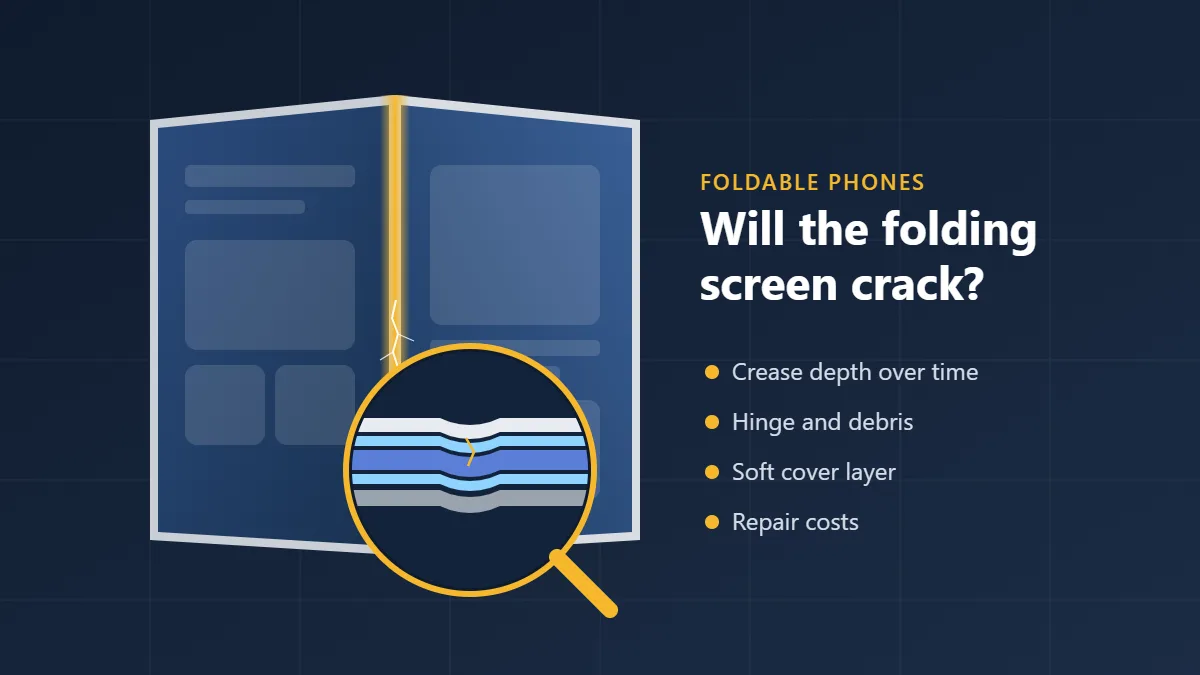
Yes, the iPhone Duo’s folding screen can crack, and on some units it already has. Within days of the October 23 launch, owners began reporting inner displays that split along the hinge during ordinary opening, often after a crunching sound and with no drop involved. Apple has acknowledged the problem affects “a small number of iPhone Duo units” and is replacing them through AppleCare. That’s a manufacturing fault rather than a verdict on iPhone Duo durability as a whole, and Apple says affected phones show it quickly.
Separate from that defect, the inner screen is more fragile than a regular iPhone screen by design. Its top layer is a polymer a fingernail can mark, its crease deepens with use, and pressure in the wrong direction can kill it. The hinge, by contrast, has held up well in every fold test published so far. Below: how Apple built the screen, what the first iPhone Duo durability tests show, what repairs cost and what to weigh before you buy.
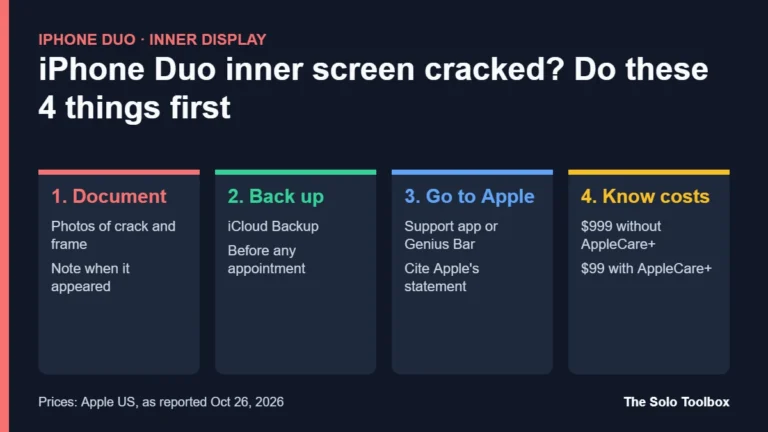
How we checked: Apple’s specs and repair prices, Bloomberg’s reporting, iFixit’s teardown and independent tests, as of October 27, 2026. We haven’t tested a Duo ourselves. If your Duo has already cracked, go straight to iPhone Duo inner screen cracked? What to do first.
In this guide
- From iPhone Fold rumors to iPhone Duo
- How a folding phone screen works, and why it’s the weak spot
- Why some iPhone Duo screens are cracking
- Is the crease on the iPhone Duo normal?
- What independent iPhone Duo durability tests found
- iPhone Duo durability vs. Samsung and Google foldables
- What an iPhone Duo screen repair costs
- Should you buy an iPhone Duo now?
- FAQ
From iPhone Fold rumors to iPhone Duo
For years, Apple’s foldable was a rumor usually called the iPhone Fold or iPhone Ultra. Durability was the theme of most leaks: supply-chain reports claimed Apple had held the phone back until it could ship a display that was nearly or entirely crease-free. Apple ended the guessing on September 9, 2026, when it announced the iPhone Duo. Here’s what Apple has now confirmed:
- Price: from $1,999 in the US for 256GB, with 512GB, 1TB and 2TB options.
- Screens: a 7.6-inch folding inner display and a 5.4-inch outer display.
- Availability: on sale October 23 in more than 70 countries and regions, with 28 more from October 30.
- Water and dust: IP68, tested to 6 meters for up to 30 minutes.
- Hinge: more than 100 components, with a grade 5 titanium body.
- Official fold rating: none. Apple hasn’t said how many folds it designed the display or hinge to survive.
That last point matters. Apple describes the Duo as built to last, but unlike Samsung it has published no fold-cycle figure, so independent tests are the only numbers buyers have.
How a folding phone screen works, and why it’s the weak spot
A regular iPhone puts its OLED panel under a thick sheet of rigid glass. A foldable can’t do that, because glass that thick would snap the first time it bent. Instead, manufacturers build the panel on a flexible base and cover it with layers thin enough to curve around a tight radius when the phone closes.
Every fold stretches one side of that stack and compresses the other. Over thousands of cycles the materials don’t spring all the way back, which leaves a shallow dip along the fold line: the crease. The hinge has two jobs that pull in opposite directions. It must hold the screen perfectly flat when open, then get out of the way when closed so the panel can curve without the hinge pinching it. If something underneath fails to move, or grit gets in, the stress lands on one narrow line of a very thin stack.
What Apple put in the iPhone Duo’s inner display
According to Apple’s own description, the inner display stacks up like this, from the surface you touch down:
- Scratch-resistant coating.
- Nano-textured cover layer made from a custom polymer that Apple says is up to 40 percent stiffer than materials used elsewhere in the industry. Its matte finish cuts glare and, Apple says, makes the crease less visible. This is the layer Apple can peel off and replace.
- High-strength glass above the folding panel.
- The folding OLED panel.
- High-strength glass below the panel.
- Custom adhesives that let the layers slide past each other like the pages of a book, so bending stress isn’t locked into any one layer.
- A titanium plate at the bottom for support.
Two practical consequences follow. First, the surface your finger touches is plastic, not glass, which is why it scratches far more easily than the outer screen. Second, the glass layers inside are thin enough to bend, which also makes them the parts that crack if something presses up from below. Several owners whose screens failed told Bloomberg the top surface was untouched while lines spread underneath, which fits that picture.
Why some iPhone Duo screens are cracking
Reports started on launch day on Reddit and the MacRumors forums. Bloomberg later verified the problem with more than half a dozen customers who supplied photos or support records. The descriptions are strikingly consistent:
- The hinge feels stuck or unusually stiff partway through opening.
- There’s a crunch or crack sound, then a crack runs along the center fold.
- A bright white or green line, or a discolored patch, appears on the right half of the inner screen and can grow with further folding.
- Owners feel a bump under the display near where the crack starts. One said the screen registered touches he wasn’t making.
- It happens within hours or days, sometimes during first setup, with no drop.
Apple’s statement to Bloomberg said most units aren’t affected, that affected units show the defect quickly, and that owners should contact AppleCare for a replacement. Apple engineers are collecting failed phones for analysis. Bloomberg’s own review unit and a second retail unit had no problems.
What could be causing the cracks
Apple hasn’t named a cause. Repair specialist iFixit told Bloomberg it believes a piece of the hinge is failing and cracking the screen, rather than the panel itself being faulty. In its teardown analysis, as quoted by 404 Media, iFixit floated two candidates: a central support bar that doesn’t retract fully as the phone closes, or the curved rails that guide the hinge rising into the screen if they don’t move as intended. Both are theories until Apple says otherwise.
What nobody outside Apple knows yet:
- How many units are affected. There is no failure-rate data.
- Whether the cause is a single part, a batch of parts or an assembly step.
- Whether Apple has changed anything on the production line.
Some perspective: first-generation foldables have a history of this. IDC analyst Francisco Jeronimo pointed out to Bloomberg that Samsung’s original Galaxy Fold also had problems in 2019, and that a fast, transparent response is what contains the damage. Samsung’s foldables are now in their eighth generation.
Is the crease on the iPhone Duo normal?
Yes. Despite the pre-launch talk of a crease-free display, Apple itself only claims its matte finish makes the crease less visible. Early reviews found it hard to spot head-on when the phone is new, but every machine test so far shows it deepening:
- HTX Studio scanned a new Duo’s crease at 48 microns deep, then measured 167 microns after 3,000 folds, about the same as one rival foldable it tested and worse than another.
- YouTuber Tim Pan (Mediastorm) ran 10,000 machine folds plus 1,000 more at around -20°C and found the crease clearly deeper to the eye and to the touch.
- Owners are already posting crease photos after a few days, and Galaxy Fold owners report the same gradual change on Samsung’s phones.
For perspective, 10,000 folds equals a few months of heavy use. Expect the crease to become noticeable, especially at an angle or under bright light, and to matter less once the screen is on. Warranty coverage for cosmetic crease depth is unclear: Apple hasn’t said whether it treats a deep crease as a defect.
Normal crease or warning sign?
| Usually normal wear | Get it checked by Apple |
|---|---|
| A smooth, shallow dip down the middle that deepens slowly | A sharp line that appears suddenly |
| Visible mainly at an angle or with the screen off | A bump you can feel under the screen surface |
| Touch and image work normally across the fold | White, green or black lines, a discolored patch, or phantom touches |
| Hinge feels the same as day one | Hinge suddenly feels stiff, stuck or gritty |
Anything in the right-hand column matches the defect pattern above. Stop folding the phone and follow the steps in our cracked iPhone Duo guide.
What independent iPhone Duo durability tests found
The tests published in the first week measure different things, so they’re worth reading side by side rather than as one verdict.
| Test | Result | Caveat |
|---|---|---|
| Joanna Stern, folding robot (32,640 folds over four nights) | Hinge felt essentially unchanged; a force gauge showed it slightly stiffer | Case on, and the phone didn’t fully close on each cycle |
| Tim Pan / Mediastorm (10,000 folds + 1,000 at about -20°C) | Hinge stayed smooth; crease noticeably deeper | One unit |
| HTX Studio (3,000 folds) | Crease depth went from 48 to 167 microns | Review unit tested before launch |
| JerryRigEverything scratch test | Outer screen marked at Mohs level 7; inner screen at level 2, and a fingernail can mark it | The matte finish hides most marks once the screen is on |
| JerryRigEverything dirt test | Sand and dirt jammed the hinge so the phone wouldn’t close | Deliberately extreme amount of debris |
| JerryRigEverything bend test | Body stayed intact; inner display got a permanent green line, then stopped responding | Bending against the hinge is abuse, not normal use |
Sources: MacTrast on Stern’s test, GadgetReview on Tim Pan’s test, iThinkDiff on JerryRigEverything’s results. CNET is also running a custom folding machine on a Duo; it had passed 55,000 folds as of October 26.
What the iPhone Duo durability results mean
So far, the pattern is clear. The hinge mechanism is strong under repeated, clean folding. The weak points are the soft top layer, debris getting into the hinge, and pressure on the unfolded screen. None of these tests reproduced the launch-week cracking, which supports the idea that it’s a defect in some units rather than a design that fails for everyone.
The dirt result, however, deserves a note. IP68 means water and dust shouldn’t get inside the sealed electronics. It says nothing about grit in the hinge’s moving parts. iFixit’s own dust test found the Duo’s hinge picked up less dust than the Galaxy Z Fold 8 or Pixel 11 Pro Fold, but enough still reached the moving parts to make it crunch. In short, keep the Duo away from beach bags and sandy pockets.
iPhone Duo durability vs. Samsung and Google foldables
Direct comparisons are hard because Apple publishes less than its rivals. Still, here’s what we can compare:
- Fold ratings: Samsung rated the Galaxy Z Fold 6 for 200,000 folds and said in 2025 that its foldable had passed a 500,000-fold test. Apple has published no figure for the Duo.
- Bend test: the Galaxy Z Fold 8 survived JerryRigEverything’s bend test with a working screen, according to Sammyfans; the Duo’s inner display did not.
- Crease: the Duo starts out shallower than most, but HTX’s measurements suggest it ages into the same range as other current foldables.
- Repair prices: Apple charges more for almost everything, as iFixit’s comparison shows.
| Out-of-warranty repair (US) | iPhone Duo | Pixel 11 Pro Fold | Galaxy Z Fold 8 |
|---|---|---|---|
| Inner (folding) display | $999 | $568 | $579 module / $419 screen repair |
| Outer display | $379 | $178 | $139 |
| Inner screen cover layer | $49 | $129 | Not listed |
The one place Apple undercuts its rivals is the cover layer. If the top layer gets scratched, Apple lists a $49 replacement, compared with $129 for Google’s folding Pixel.
What an iPhone Duo screen repair costs
Apple’s one-year limited warranty covers manufacturing defects for free, and that’s how Apple is handling the hinge cracks. The prices below apply when Apple decides the damage is accidental. These are Apple’s US estimates as compiled by iFixit:
| Repair | Without AppleCare+ | With AppleCare+ |
|---|---|---|
| Inner screen cover layer | $49 | $19 |
| Back glass | $199 | $29 |
| Battery service | $229 | $0 |
| Outer display | $379 | $29 |
| Inner display | $999 | $99 |
| Other damage | $1,499 | $99 |
Is AppleCare+ worth it for the iPhone Duo?
AppleCare+ with Theft and Loss for the Duo costs $19.99 a month, $199.99 a year or $399 up front. The math is simple: two years of monthly coverage plus one inner-display claim comes to about $579, compared with $999 for that single repair without it. Two claims and the gap widens to more than $1,400.
Also, don’t count on cheap third-party repairs soon. iFixit expects the Duo’s parts to be expensive and the repairs difficult, which will keep independent shop prices high too. Insurers are cautious for the same reason: a UK refurbishment executive told Mobile News the Duo is likely to be treated as a higher-risk device.
Finally, leave the cover layer alone. JerryRigEverything showed it can be peeled off, but he suspects Apple treats it as part of the screen’s structure, and doing it yourself gives Apple a reason to call later damage accidental.
Should you buy an iPhone Duo now?
If you don’t need one right away, waiting a couple of months is the low-risk choice. It gives time for real-world iPhone Duo durability data to build up, for Apple to explain the cracks, and for any production fix to reach stores. iFixit’s own advice is to wait a few months, or for a second-generation model.
How to lower the risk if you buy now
If you’re buying now, you can still limit the risk:
- Buy from Apple if you can. Several owners walked out of Apple Stores with same-day replacements, though some stores had no stock to swap. Apple told one buyer without a nearby store to mail the phone in and go without it for more than a week before Apple agreed to express-ship a replacement.
- Use it heavily in the first two weeks. Apple says affected units fail quickly, and Apple’s return window is 14 days. Fold and unfold it normally and often while you can still return it.
- Add AppleCare+. On a phone with a $999 screen, it’s the cheapest way to cap your worst case.
- Keep the hinge clean. Avoid sand, lint-heavy pockets and dusty work sites.
- Don’t press hard on the open screen. No leaning on it, no pressing the crease, no bending it back past flat.
- Skip third-party inner screen protectors until Apple says what’s safe. The cover layer is already the sacrificial layer.
- Back up automatically. A replacement means a new device, so turn on iCloud Backup before anything goes wrong.
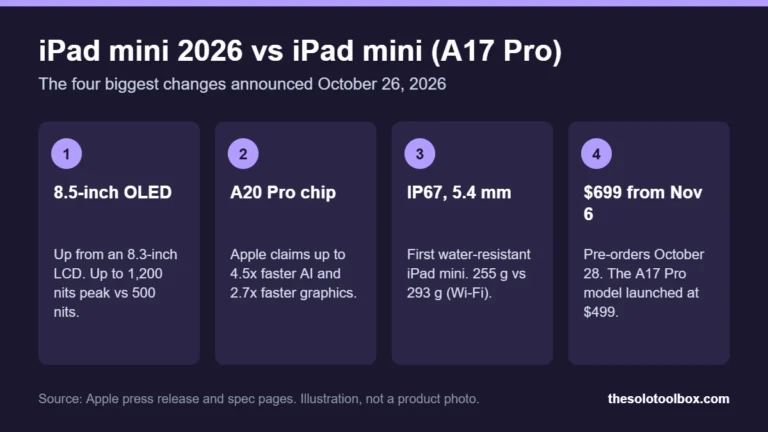
If the phone is your main work device, plan for downtime. A week without your business number costs more than AppleCare+, so either keep coverage or keep an older phone ready as a backup. If you mainly want a bigger screen for reading and documents, a small tablet is cheaper and tougher; our iPad mini 2026 comparison covers Apple’s other launch this week.
FAQ
Yes, on some units. Owners have reported inner displays cracking along the hinge during normal opening, within hours or days of purchase and without a drop. Apple says this affects a small number of units and is replacing them through AppleCare.
Apple hasn’t published a fold rating. In independent tests, the hinge felt essentially unchanged after more than 32,000 robot folds, while the crease became noticeably deeper after 10,000. For crease warning signs, see the normal-or-warning table above.
Apple lists $999 for inner display damage without AppleCare+ and $99 with it. Replacing only the inner screen’s cover layer costs $49, or $19 with AppleCare+. Apple repairs manufacturing defects free under warranty.
It’s rated IP68, tested to 6 meters for up to 30 minutes. That rating covers water and dust getting into the sealed electronics, not grit in the hinge: in JerryRigEverything’s test, sand and dirt jammed the hinge so the phone wouldn’t close.
Apple hasn’t published guidance on third-party protectors for the inner screen. Its replaceable cover layer already acts as the sacrificial top layer, so it’s safest to leave it alone and avoid peeling it.
There’s no like-for-like data yet. Samsung publishes fold ratings and the Fold 8 reportedly survived JerryRigEverything’s bend test, which the Duo’s inner screen did not. The Duo’s hinge has held up well in fold tests, but its repairs cost more.
The bottom line on iPhone Duo durability
The iPhone Duo’s folding screen can crack, but the cracks making headlines look like a defect in some early units, which Apple is replacing, rather than proof the design is fragile. The hinge has passed every fold test published so far. What is fragile is the part every foldable struggles with: a soft top layer, a crease that deepens with use, and a $999 inner display that doesn’t tolerate grit or pressure. Buy it with AppleCare+ and a two-week stress test, or wait a few months and let the early adopters find out the rest.
Related guides
- iPhone Duo inner screen cracked? What to do first
- iOS 26.7.2 or iOS 27.2: which iPhone update to install
- iPad mini 2026 vs iPad mini (A17 Pro): what changed and should you upgrade
Sources
- Apple Newsroom: Apple unveils iPhone Duo (Sept 9, 2026)
- Bloomberg: Apple’s foldable iPhone Duo draws early complaints of the screen cracking (Oct 26, 2026); full text via Business Standard
- iFixit: How the iPhone Duo’s repair prices compare
- 404 Media: iPhone Duo users are already seeing a crease (Oct 26, 2026)
- Notebookcheck: iPhone Duo repair costs and AppleCare+ pricing
- iThinkDiff: JerryRigEverything iPhone Duo durability test and HTX Studio crease measurements
- MacTrast: Joanna Stern’s 32,000-fold hinge test
- Android Authority: iPhone Duo fold and crease tests
- Tom’s Guide: owners report screens cracking at the hinge